
Visual design, aesthetics, dynamics and sonification
Visualization of Polyhedral Inner Chambers with Psychosocial Implications (Part #10)
[Parts: First | Prev | All] [Gallery] [Links: To-K | From-K | From-Kx | Refs ]
As inferred from the literature search, there appears to be no accesible imagery of the "internal chambers" explored here. Their existence may be implied by geometry but the constraints of 2D representation inhibit any support they might provide for the imagination. Whilst the script provided a basis for their discovery and representation in 3D, the individual models generated in X3D called for manual modification to further reduce cluttter and highlight configurations of significance. Of particular relevance is the fact that the simpler models generated -- of the "innermost chambers" -- are a prelude to discovery and representation of the many which encompass them concentrically.
The models are therefore a major challenge to design -- especially as a trigger for imaginative reflection and memorability. This calls for a variety of selective considerations of colour, proportion, and the like -- preferably enhance by dynamics and even sonification. The design challenge can be recognized as one of "tuning" for the combination of script parametrs and X3D options invites recognition of the device as a kind of insrument, potentially comparable in its complexity with a musical organ, as speculatively discused separately (Envisaging a Comprehensible Global Brain -- as a Playful Organ, 2019).
The device might be developed to facilitate its interactive use, enabling users to moduify the design options according to preference. The possibility recalls the role of "multiplication tables" as a means of engaging memorably with the array of numbers. This suggests the potential value of a geometrical analogue in order to enable contrasting configurations of order to be explored -- with or without complementary sonification.
| Nesting 5 Platonic polyhedra (octahedron, icosahedron, dodecahedron, tetrahedron, cube) | Rotation of 12 Archimedean polyhedra (in cuboctahedral array) | |
| Polyhedral model of the solar system (Johannes Kepler, Mysterium Cosmographicum, 1596) | Animation of rhombic triacontahedron (green) as a "nesting framework" for polyhedral dynamics | (rotation around an omitted 13th at the centre; totalling 984 edges, 558 vertices, 452 faces) |
 |  |  |
| Reproduced from Wikipedia entry | Virtual reality variants static: vrml or x3d; mutual rotation: vrml or x3d; "pumping": vrml or x3d; videos: "pumping" mp4; "rotation" mp4 | Virtual reality variant (.wrl) |
The images above suggest various design approaches to facilitate comprehension of the set of regular polyhedra as exemplars of ordered symmetry, as discussed separately (Psychosocial Implication in Polyhedral Animations in 3D, 2015). Further possibilities are suggested by jitterbug transformations and morphing between polyhedra.
Of particularl relevance is the potential cognitive significance of "cosmograms", following Kepler's early initiative in that regard, as discussed separately with images reproduced below (Nesting polyhedral configurations within cosmograms and "cosmohedra", 2023; F. M. Velásquez-Fernández, et al Construction and Analysis of Kepler’s Cosmographic Mystery, for Learning the Platonic Solids Using Mathematica. Proceedings of Seventh International Congress on Information and Communication Technology. Lecture Notes in Networks and Systems, 448. 2023
The symmetry preserving operations (associated with the Conway polyhedron notation) can be understood as related to the challenge of memetic compactification, as discussed separately (Closest packing of concepts and compactification of insight, 2023; Harmonizing dissonance via polyhedral symmetry-preserving operations, 2024). One approach to representation is through the cosmogram (Nettrice R. Gaskins, Semantic Symbology: the evolution and amplification of cosmograms, Journal of Visual Art Practice, 20, 2021, 3). In 3D these may be experimentally depicted as nested polyhedra, reproduced below (Polyhedral cosmograms as Rosetta Stones -- cosmohedra? 2023).
| Animations of a variety of "Leonardo Cosmograms" (with suggestive attribution of 6 distinct cognitive modalities on left) | |||
 |  | 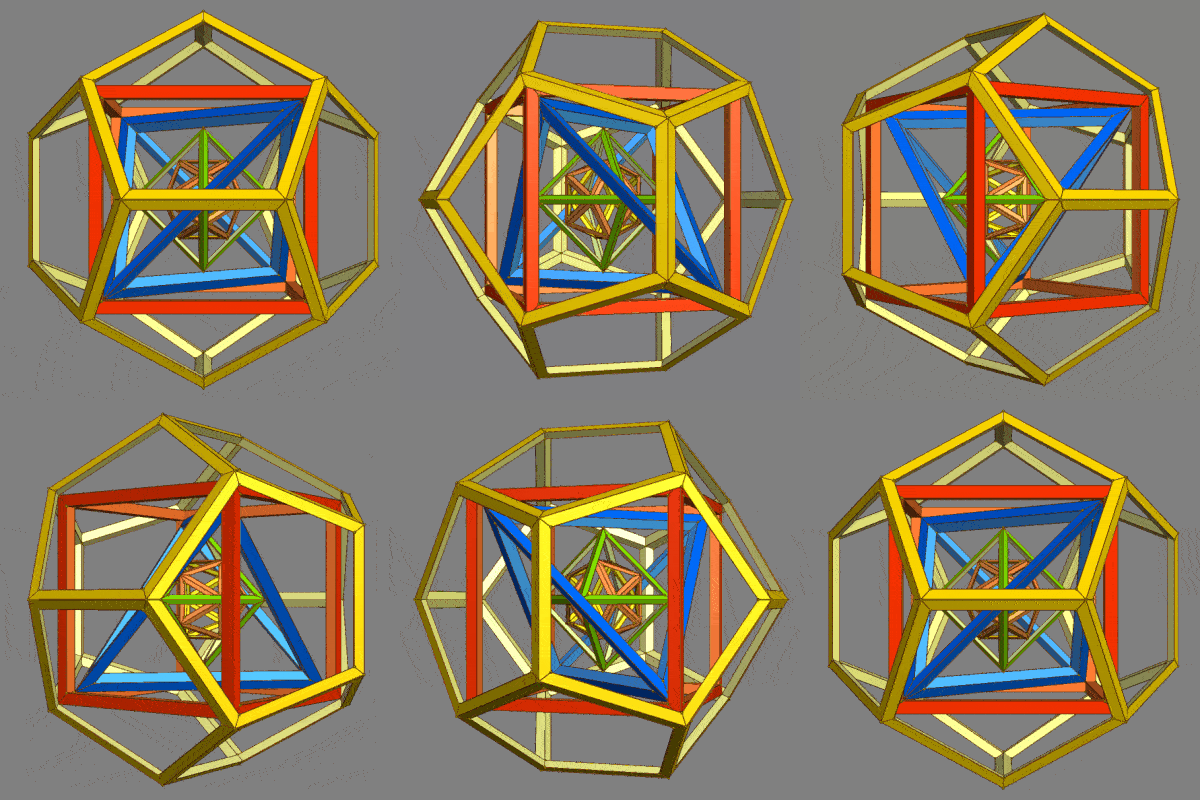 | 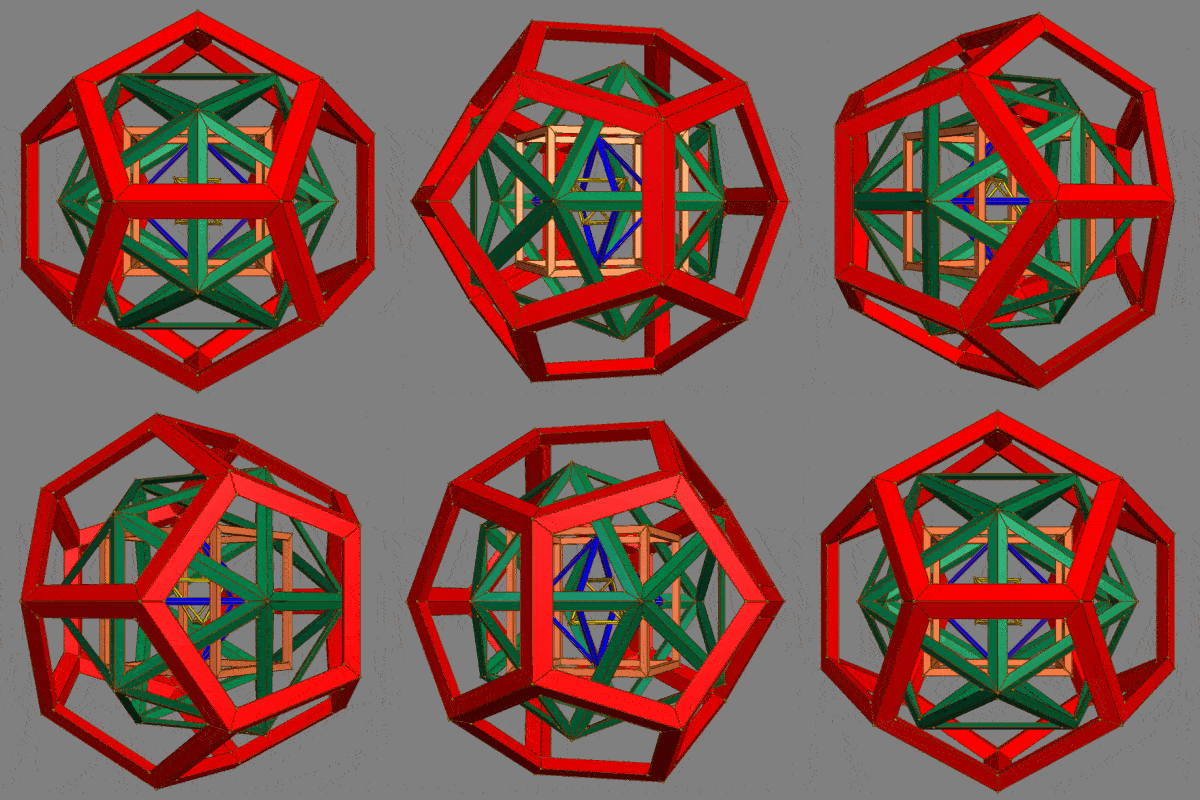 |
| Animations prepared with the aid of Stella Polyhedron Navigator | |||
[Parts: First | Prev | All] [Gallery] [Links: To-K | From-K | From-Kx | Refs ]