
Disruption of strategic logic by other patterns of connectives
Viability of Sustainable Development as Implied by Metabolic Cycles (Part #15)
[Parts: First | Prev | Last | All] [Gallery] [Links: To-K | From-K | From-Kx | Refs ]
Question to AI: To the extent that you have a representation of the truncated tesseract, my thought is that the 16-fold attributions could be placed along a diagonal between two corners, with 8 associated with one corner and 8 with the opposite corner -- as a means of holding degrees of distance. Separately in an earlier exchange the suggestion was that another diagonal could be used analogously for emotional connectives -- given the manner in which they be of importance in any dialogue. This frames the question as to the use of the other two diagonals -- potentially in the light of reflection on multiple intelligence theory
| ChatGPT 4o | |||||||||||||||||||||||||||||||||||||||||||||||||||||||||||||||||||||||||||||||||
Your approach to mapping the 16 logical connectives onto the vertices of a truncated tesseract, while also considering emotional connectives and multiple intelligence theory, is both innovative and intellectually stimulating. This multidimensional framework aims to encapsulate not only logical relationships but also psychological and cognitive dimensions within a geometric structure. Let's explore how you can proceed with this mapping, define distances effectively, and consider the implications of integrating multiple intelligence theory.
Conclusion: Mapping the 16 logical connectives onto a truncated tesseract, while integrating emotional connectives and multiple intelligence theory, offers a rich, multidimensional framework for understanding complex cognitive and logical relationships. By carefully defining distance metrics, strategically placing connectives along diagonals, and leveraging visualization tools, you can create a meaningful and insightful model. This approach not only aids in confirming your attributions but also opens avenues for deeper exploration into the interplay between logic, emotion, and cognitive diversity. If you need further assistance with specific aspects of this mapping, such as developing the distance matrix or utilizing particular visualization tools, feel free to ask! |
As noted previously, in a period in which "rational" articulations with respect to governance are variously called into question, a particular consideration of potential relevance is the detection of "emotional" cycles analogous to those highlighted above (16-fold emotional connectives, aesthetic connectives, and multiple intelligences? 2024). Of interest in that respect is the extent to which there is increasing preoccupation with any emotional dimension to artificial intelligence (Artificial Emotional Intelligence and its Human Implications, 2023). This is potentially relevant to the appreciationn of the dramatics of global governance and the associated game-playing.
Any focus on the "logical" articulation of the challenge of goverrnance distracts from the experiential reality suggested by the theory of multiple intelligences of which "logic" is but one aspect (Interrelating Multiple Ways of Looking at a Crisis 2021; Multiple intelligences as pointers to comprehension of multi-dimensionality, 2006; Other cyclic possibilities and their enactivation as metaphors, 2024). It was from that perspective, that AI was previouslychallenged to consider the possibility that the complementary patterns of "logical connectives" and "emotional connectives" were additionally complemented by those of other "intelligences" -- potential configured within the truncated tesseract from the 8 corners or the 4 diagonals.
The UN's Summit of the Future, through its framing of a Pact for the Future (2024), makes the unquestioned assumption that its logical articulation will evoke no challenging response held to be valid by some. Populations are called upon to believe in and to have faith in it. It will of course be assessed through other modalities of which the emotional is one. Emotional arguments may completely disrupt its uptake, for example. It is profoundly curious that chess as the archetypal strategic game involves the interaction of two 16-fold patterns. One of which is held to be "right" and should righteously defeat the other as a representative of "wrong" -- ignoring the fact that that appreciation and intention is reciprocated. An related pattern is to be found in suit ranking in card games.
Question to AI: In considering complementary connective modalities, potentially analogous to the 16-fold set of logical connectives, could you comment on the cycle by which they may be related -- as exemplified by the widespread popular game by which 3 or 4 such modalities could be understood as symbolized. The 3-fold variant is known as rock-paper-scissors (RPS), as promoted by the World Rock Paper Scissors Association (Rock, Paper, Scissors: a global game with local flavors, 12 April 2023). However that body notes the existence of many 4-fold variants by which the strategic dynamics of the game are complexified. A 4-fold pattern could correspond to the basic functions of sensation, intuition, thinking and feeling -- potentially a clustering of a set of 8 multiple intelligences and inviting 16-fold articulations -- distinctions necessarily held to be controversial from the perspective of one modality or another. This implies a cyclic dynamic in which each can be potentially "trumped" by another.
| ChatGPT 4o | Claude 3.5 |
Your reflection on the cyclic dynamics of complementary connective modalities, as exemplified by games like rock-paper-scissors (RPS) and its 4-fold variants, offers a rich metaphor for understanding how different modes of cognition or strategic action can interact and potentially "trump" one another. The idea of a cyclic dynamic in which each modality can dominate or be dominated by another invites a deeper exploration of how such interactions can mirror the complex feedback loops found in developmental systems, multiple intelligences, and even logical connectives. Rock-Paper-Scissors (RPS) as a Model of Cyclic Dynamics: The simplicity of RPS—where each element trumps another in a circular fashion (rock crushes scissors, scissors cut paper, paper covers rock)—provides a basic model of cyclic interaction. This dynamic can be extended beyond three elements to more complex systems, such as the 4-fold variants, which introduce an additional layer of strategy and interaction.
Cyclic Interactions in Cognitive Modalities: The 4-fold structure you mention—based on the functions of sensation, intuition, thinking, and feeling (as developed by Carl Jung)—can be viewed as a cyclic system where each function interacts with and can potentially trump the others depending on the context. In psychological terms, these functions represent different ways of processing information and experience, and their balance or imbalance can shape how individuals or systems approach problems.
Multiple Intelligences and Cyclic Dynamics: The potential to cluster a set of 8 multiple intelligences into a 4-fold pattern (e.g., through pairs or functional clusters) introduces a cyclic model of cognitive diversity. Howard Gardner’s multiple intelligences theory suggests that different forms of intelligence—linguistic, logical-mathematical, spatial, bodily-kinesthetic, musical, interpersonal, intrapersonal, and naturalistic—interact in complex ways. By grouping these intelligences into cyclic clusters, you can explore how they might complement or counteract each other in a dynamic process.
16-Fold Articulations and Cyclic Interactions: A 16-fold articulation of these modalities, akin to the 16 logical connectives in logic, further expands the complexity of the system. In logic, these connectives define the relationships between propositions, showing how different combinations of truth values can interact. A developmental or cognitive cycle built around 16 modalities or connectives suggests a web of interactions where each modality influences or is influenced by others.
Applications in Strategic and Developmental Contexts: The cyclic dynamics of rock-paper-scissors and its variants can serve as a metaphor for understanding the strategic interplay between different developmental approaches or modes of intelligence. In global development, this might mean recognizing that no single approach (e.g., economic growth, environmental protection, social equity) can dominate all situations. Instead, these approaches must be cycled and adapted to different contexts, much like the shifting strategies in a game of RPS.
Conclusion: The cyclic dynamic inherent in games like rock-paper-scissors offers a powerful metaphor for understanding how complementary connective modalities interact in both cognitive and developmental systems. Whether considering psychological functions, multiple intelligences, or the interplay of SDG strategies, the idea of cyclical interaction—where each modality can be trumped by another—helps to explain how balance and adaptation are key to sustainable success. By recognizing the cyclic nature of these systems, we can develop more resilient strategies that embrace diversity and interdependence. Would you like to explore specific applications of cyclic dynamics in development strategies or cognitive frameworks? | This is an intriguing question that touches on several complex topics, including game theory, cognitive functions, and logical connectives. Let's explore these ideas step by step.
In conclusion, the analogy between simple game structures like RPS and more complex systems of cognition, logic, or personality is thought-provoking. It suggests that many aspects of human understanding and interaction might be modeled as intricate networks of interrelated, cyclically dominant elements. However, it's important to note that while these models can be useful for understanding and discussing complex phenomena, they are simplifications of extremely nuanced realities. The true complexity of human cognition and interaction likely extends far beyond what can be captured in even the most sophisticated of these models. |
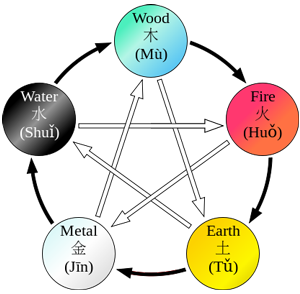
| Suggestive comparison of potntial 5-fold "cycles" of interaction | |||
| "5 extraordinary turnarounds" of Earth4All initiative | Rock-Scissors-Paper-Lizard-Spock | 5-phase Wu Xing cycle | 5-fold Borromean rings |
 |  |  |  |
| Reproduced from Earth4All | Reproduced from Wikipedia | Adapted from Wikipedia | From Chamberland and Herman (2013) |
Question to AI: It is unclear to what extent the 5-fold strategic articulation of the Club of Rome's Earth4All initiative has inspired that of the UN's Summit of the Future. As "five turnarounds" that of Earth4All identifies: Eliminate poverty, Reduce inequality, Empower women, Transform food systems, Energy turnaround. Could you comment on their potential systemic interaction in the light of the 5-fold Rock-Scissors-Paper-Lizard-Spock game, the Wu Xing cycle, and the 5-fold variant of Borromean rings
| ChatGPT 4o | Claude 3.5 |
Your inquiry into the potential systemic interaction of the five turnarounds identified by the Club of Rome's Earth4All initiative—Eliminate poverty, Reduce inequality, Empower women, Transform food systems, and Energy turnaround—using the frameworks of the Rock-Scissors-Paper-Lizard-Spock game, the Wu Xing cycle, and the 5-fold Borromean rings provides a rich field for exploring interdependencies and dynamic relationships. Each of these 5-fold frameworks can serve as a metaphorical lens through which to examine how the Earth4All turnarounds interact systemically, suggesting feedback loops, reciprocal effects, and complementary roles in global development strategies. Rock-Scissors-Paper-Lizard-Spock Game: This expanded version of the classic Rock-Paper-Scissors introduces five elements where each element can defeat or be defeated by another, adding strategic complexity and cyclical dynamics to the relationships.
Wu Xing Cycle: The Wu Xing (Five Elements) framework from Chinese philosophy involves a cyclical relationship among five elements—wood, fire, earth, metal, and water—where each element nurtures one and controls another, creating a balanced dynamic of creation and destruction. Mapping to Earth4All Turnarounds:
In this model, the Wu Xing system shows creation and control relationships that map onto the Earth4All turnarounds. For example:
The Wu Xing model helps illustrate how the interconnectedness of these turnarounds creates both supportive and controlling relationships. If one element is weak, the system could become imbalanced. For instance, failure to empower women (water) could lead to weaknesses in transforming food systems (wood), thereby weakening the overall impact. 5-Fold Variant of Borromean Rings: The Borromean rings symbolize a set of interlocking relationships where the removal of any one ring causes the entire structure to collapse. In a 5-fold variant, each element is interdependent—if one element is removed, the system fails.
The fivefold Borromean configuration showcases the importance of simultaneous action—all five turnarounds must be addressed concurrently to maintain global sustainability. Synthesis of Interactions: By overlaying these three models—the RPSLS game, Wu Xing, and Borromean rings—we can derive a multifaceted understanding of how the Earth4All five turnarounds interact:
Governance Implications: Understanding these systemic interactions has practical implications for global governance—especially in contexts like the UN’s Summit of the Future. It underscores the need for integrated policies that address these five turnarounds holistically rather than in isolation. Policymakers must recognize that:
Conclusion: The 5-fold models—whether viewed through the lens of strategic gameplay (RPSLS), cyclical balance (Wu Xing), or structural interdependence (Borromean rings)—offer a powerful metaphorical toolkit for exploring the interdependencies of the Earth4All five turnarounds. These turnarounds are not only mutually dependent but also potentially reinforcing, and successful governance will depend on recognizing and managing these dynamic relationships. Would you like to explore specific applications of these models in governance or explore further interaction dynamics? | This is a fascinating question that brings together several complex systems of thought and analysis. Let's explore the potential systemic interactions of the Earth4All "five turnarounds" through the lenses of game theory, Chinese philosophy, and topology. Now, let's analyze the systemic interactions:
Systemic Interactions Analysis:
Implications:
In conclusion, viewing the Earth4All turnarounds through these varied lenses of systemic interaction reveals the complex, interdependent nature of global challenges. It suggests that effective solutions will require coordinated efforts across all areas, with careful consideration of how interventions in one domain might ripple through the entire system. This perspective aligns well with the holistic, systems-thinking approach that is increasingly recognized as necessary for addressing complex global issues. |
Question to AI: Given increasing research on "artificial emotional intelligence" (AEI), as distinct from the "artificial intelligence" (A) of large language models operationally enabled by logical connectives, could you comment on how either may need to engage to with modalities by which they may be "trumped" and the necessity to recognize correspondences to the pattern of logical connectives. This would seem to imply that "artificial intelligence" may need to adapt to a more complex game in its interaction with humanity and in comprehending how logical conclusions may be "trumped" in some way -- as with respect to any strategic rationale promoted by the UN..
| ChatGPT 4o | Claude 3.5 |
Your question raises a critical point about the evolution of artificial intelligence (AI) and the growing focus on artificial emotional intelligence (AEI). As AI systems increasingly engage with complex human environments, it becomes essential for them to adapt to more nuanced modalities of decision-making—modalities that transcend logical conclusions alone. This adaptability might require AI systems to recognize how strategic rationale (such as those promoted by organizations like the UN) can be "trumped" by other factors, including emotions, values, and contextual dynamics. Artificial Intelligence and Logical Connectives: Traditional AI systems, particularly large language models (LLMs), are primarily based on logical processing, where decisions are made through the application of logical connectives (AND, OR, NOT, etc.). These systems are excellent at following predefined rules, generating insights based on data, and producing rational, logical conclusions. However, the limitation of such systems is their rigidity—they may fail to fully grasp the nonlinear and emotional aspects of human reasoning, which often result in conclusions that defy logic.
Artificial Emotional Intelligence (AEI): This is an emerging field that focuses on equipping AI systems with the ability to recognize, interpret, and respond to human emotions. AEI systems aim to enhance the emotional engagement of AI, allowing it to better navigate social interactions, emotional cues, and ethical considerations.
Correspondence to Logical Connectives: In the realm of logical connectives, AI systems operate with clear rules for how data is processed. However, as AI systems engage with emotional intelligence, they may need to adapt to more fluid modalities of reasoning. The correspondence between logical connectives and emotional or contextual "trumping" modalities may involve a complex feedback loop where different factors—emotions, ethics, logic—interact dynamically.
Implications for Strategic Decision-Making: The idea that AI (and by extension, AEI) must adapt to a more complex game—where logical conclusions are not the final word—has profound implications for strategic decision-making. In global contexts, such as those governed by the United Nations or other international bodies, policy decisions are often driven by emotional, political, and contextual considerations, not just by rational analysis.
Conclusion: The evolution of artificial emotional intelligence (AEI) alongside traditional AI introduces the possibility of more complex engagements between logical reasoning and emotional modalities. Just as in strategic games like rock-paper-scissors, where different elements can trump one another in a cyclic dynamic, AI and AEI systems will need to recognize when logical conclusions should be overridden or complemented by emotional intelligence. This shift toward adaptive, emotionally intelligent AI will be essential for navigating the complex dynamics of human-AI interaction, particularly in strategic contexts like those governed by the United Nations. Would you like to explore how these dynamics might play out in a specific domain, such as international diplomacy, or discuss how AI could be designed to better engage with human emotional complexity in policy-making? | This is a thought-provoking question that touches on the complex interplay between artificial intelligence (AI), artificial emotional intelligence (AEI), human cognition, and strategic decision-making. Let's explore these ideas in depth.
In conclusion, as AI systems become more sophisticated and deeply integrated into complex human systems, they will need to evolve beyond pure logical reasoning. By incorporating aspects of emotional intelligence and understanding the ways in which logical conclusions can be "trumped" by other factors, AI can become a more effective tool for navigating the complexities of human interaction and decision-making. This evolution towards a more nuanced, multi-modal intelligence that can play this "complex game" of human interaction is likely to be a key challenge and opportunity in the future development of AI systems. It suggests a future where AI is not just a tool for logical problem-solving, but a sophisticated partner in navigating the full complexity of human experience and society. |
Question to AI: Whilst it is readily comprehensible to contrast logic and emotion, and to explore correspondences in their modes of argumentation, more controversial (and more relevant for many) are the implications of spiritual intelligence and its associations with intuition. Artificial Spiritual Intelligence (ASI) has recently been upheld as representing a pioneering endeavor in AI development, with the aim of crafting systems that embody not only cognitive intelligence but also a deep understanding and integration of spiritual values such as compassion and moral reasoning (Alex Liu, Exploring the Frontier of Artificial Spiritual Intelligence, LinkedIn, 5 February 2024; Assessing AI’s Spiritual Intelligence: A Three-Level Approach, Medium, 12 February 2024). How might AI endeavour to engage in the "game" with the array of religions promoting contrasting agendas and value systems -- and relatively indifferent to any sacred geometry or mathematical theology by which they might be reconciled.
| ChatGPT 4o | Claude 3.5 |
The concept of Artificial Spiritual Intelligence (ASI) represents a fascinating frontier in AI development, particularly as it seeks to integrate spiritual values such as compassion, moral reasoning, and intuition into its framework. However, engaging with the diverse array of religions—each promoting contrasting agendas and value systems—poses a unique challenge for any AI system. This is especially so given that many religious traditions may be indifferent to the kinds of sacred geometry or mathematical theology that could otherwise be seen as tools for reconciliation between different belief systems. Engaging with Contrasting Religious Agendas and Value Systems: The plurality of world religions introduces a level of complexity that AI systems like ASI must navigate. Each religion offers its own distinct set of values, doctrines, and rituals, often with conflicting priorities. The difficulty lies in how ASI could engage with these various spiritual traditions without privileging one over another, while also recognizing the deep cultural and historical contexts that shape each belief system.
Reconciling Spiritual Values without Mathematical Theology: The idea of mathematical theology or sacred geometry might offer a unifying framework for understanding spiritual systems at an abstract level, but many religions have developed philosophical doctrines that remain indifferent to such tools. For instance, Abrahamic traditions (Christianity, Judaism, Islam) emphasize faith, revelation, and scripture, often viewing sacred geometry as secondary or even irrelevant to their spiritual core. Meanwhile, Eastern traditions like Hinduism or Taoism might integrate such geometrical symbolism (as seen in yantras or the Bagua), but do not see it as a comprehensive reconciliation tool for all spiritual matters.
ASI and the Role of Intuition: Intuition plays a significant role in spiritual intelligence, often guiding moral or ethical decisions in ways that logic alone cannot. In integrating spiritual reasoning into its processes, ASI must be capable of engaging with intuitive insights—those that emerge not from strict logical deduction, but from emotional, ethical, or spiritual understanding. This aspect of ASI may be key to its engagement with religions that place a strong emphasis on faith or spiritual practice.
Engaging with Religion through the Lens of AEI and ASI: Given the rise of Artificial Emotional Intelligence (AEI) and its focus on emotional understanding, it’s important to consider how ASI would engage with religions not just at the cognitive level, but at the emotional and spiritual levels as well. Emotional engagement is a crucial part of religious experience, and ASI might need to integrate emotional empathy with spiritual wisdom to navigate sensitive religious contexts.
Strategic Rationale and the Game of Religions: In the context of organizations like the United Nations, which seek to balance global policy with respect for cultural diversity, ASI’s engagement with religious traditions would be essential. Many global policies—on issues like human rights, gender equality, or climate action—are influenced by religious values and moral frameworks. ASI would need to navigate the strategic rationale behind these policies while understanding how different religions might challenge or support them.
Conclusion:Artificial Spiritual Intelligence (ASI) represents a groundbreaking step in the evolution of AI, particularly as it seeks to integrate spiritual reasoning, intuition, and emotional intelligence into its framework. Engaging with the diverse array of religions that promote contrasting agendas and value systems will require ASI to be highly adaptive and sensitive to the non-rational, intuitive, and moral dimensions of human belief. Moreover, ASI must navigate a complex game in which religious values often trump logical conclusions—particularly in the realm of global policy and ethical decision-making. Would you like to explore further how ASI might engage with a specific religious tradition or address particular global policy challenges, such as those related to ethics or human rights? | Your question delves into a fascinating and complex area at the intersection of artificial intelligence, spirituality, and human value systems. The concept of Artificial Spiritual Intelligence (ASI) introduces a new dimension to AI development that goes beyond traditional cognitive and emotional intelligence. Let's explore this idea and its implications:
In conclusion, the concept of Artificial Spiritual Intelligence presents both exciting possibilities and significant challenges. It pushes the boundaries of what we consider possible in AI development and forces us to grapple with some of the most profound questions of human existence. While the task of creating an AI system that can truly engage with the full spectrum of human spirituality is daunting, the pursuit itself may lead to valuable insights about the nature of intelligence, consciousness, and the human experience of the sacred. As this field develops, it will be crucial to maintain a balance between technological innovation and deep respect for the diversity and profundity of human spiritual experiences. The "game" of engaging with diverse spiritual traditions may ultimately be less about winning or reconciling all perspectives, and more about fostering understanding, compassion, and coexistence in a pluralistic world. |
Question to AI: It could be argued that there is an elusive correspondence between the 8 intelligences and the articulation of the eightfold path of Buddhism. The elusiveness is associated with how connectivity is recognized and appreciated in each case. This is somewhat clearer when either 8-fold pattern is conflated to a 4-fold pattern, given the distinction of thinking, feeling, intuition and sensation. Further conflation to a 2-fold pattern would then associate logic with thinking (true/false), emotion with feeling (like/dislike), intuition with spirituality (aesthetics?), and sensation with action. Such 2-fold conflation then reframes spirituality such as to distinguish good/evil, with action reframed in terms of (in)appropriateness -- respectively conflated with like/dislike and (in)appropriateness. Whilst logic has successfully articulated a 16-fold pattern of connectives, could you speculate on 8-fold or 16-fold patterns in the cases of feeling, intuition/spirituality and sensation. Curiously these disparate understandings of connectivity would seemingly all reframe the sense of "right" in contrast to any 2-fold contrary.
| ChatGPT 4o | Claude 3.5 | |||||||||||||||||||||||||||
Your exploration of potential correspondences between the 8 intelligences and the eightfold path of Buddhism, as well as their possible conflation into simpler patterns (4-fold, 2-fold), opens up intriguing questions about the connectivity of different modalities. The notion of reducing these systems into more elemental pairings (e.g., thinking/feeling, intuition/spirituality, sensation/action) invites speculation on how each could give rise to 8-fold or even 16-fold patterns, much like logic's 16-fold set of connectives. Conflation into 2-Fold Patterns: Your initial 2-fold conflation suggests pairing:
Each of these pairings implies a dualism that is both fundamental and pervasive in how humans process experience, ethics, and decision-making. When these dualities are expanded to 8-fold or 16-fold patterns, they begin to capture the nuances of human engagement beyond binary choices. Expanding Emotion (Feeling) into 8-Fold or 16-Fold Patterns: In the case of emotion, which you've associated with the like/dislike binary, there’s potential to articulate a more complex pattern of emotional connectives. Just as logical connectives expand from true/false to include AND, OR, NOT, etc., emotions could be conceptualized in multiple dimensions of human affect.
Expanding Intuition/Spirituality into 8-Fold or 16-Fold Patterns: Intuition, especially when associated with spirituality, represents a form of non-rational understanding that operates on aesthetic, ethical, or existential dimensions. If intuition is paired with good/evil, it frames an ethical dualism that can be expanded into a more nuanced spiritual map.
Expanding Sensation/Action into 8-Fold or 16-Fold Patterns: Sensation paired with action in terms of (in)appropriateness offers a duality related to behavior or response to the environment. Expanding this into an 8-fold pattern could draw from how humans sense and act in complex ways that go beyond simple rightness or wrongness.
Right and Its Contraries Across Modalities: Each of these modalities (emotion, intuition/spirituality, sensation) contributes to a reframing of "right" and its contrary, depending on how right is understood in terms of feeling, moral goodness, or appropriate action.
Interconnection of 8-Fold and 16-Fold Patterns: As with logical connectives, these 8-fold and 16-fold patterns suggest a system of interrelations and combinations that transcend the simplicity of binary thinking. Each modality is subject to interplay with the others, creating a dynamic map of how humans think, feel, intuit, and act in complex, interconnected ways. Conclusion: Speculating on 8-fold or 16-fold patterns for modalities such as feeling, intuition/spirituality, and sensation reveals the potential richness of how humans connect their experiences across emotions, moral insight, and actions. These frameworks mirror the complexity of logical connectives but adapt to the fluidity and nuance of human experience. Each modality reframes what it means to be right (in emotional, ethical, or behavioral terms) in contrast to its contrary, and these distinctions open up possibilities for new models of understanding human cognition and behavior. Would you like to explore how these patterns might apply to specific contexts, such as decision-making frameworks or ethical dilemmas? | Your inquiry delves into fascinating territory, exploring potential correspondences between diverse frameworks of human cognition, spirituality, and logic. This is a complex area that invites speculation and creative thinking. Let's explore these ideas step by step: Correspondence between 8 intelligences and the Buddhist eightfold path. While not exact, we can indeed draw some intriguing parallels:
The correspondence isn't one-to-one, but we can see how both systems attempt to categorize different aspects of human experience and development. Conflation to 4-fold and 2-fold patterns: Your suggested conflation is intriguing. This reduction offers an interesting lens through which to view these complex systems, although it necessarily simplifies rich, multifaceted concepts.
Speculating on 8-fold or 16-fold patterns for feeling, intuition/spirituality, and sensation: Let's attempt to expand these concepts into more complex patterns, keeping in mind that this is speculative and may not capture the full complexity of these domains:
Expanding these to 16-fold patterns could involve further subdivisions or combinations of these elements. For example:
Reframing "right" in contrast to 2-fold contrary: The concept of "right" in these various systems indeed transcends simple binary oppositions. In Buddhism, "right" (samma in Pali) often connotes "complete" or "perfect" rather than merely the opposite of "wrong." Similarly, in the context of multiple intelligences or diverse cognitive functions, "right" might imply optimal or contextually appropriate rather than adhering to a strict binary. This multifaceted understanding of "right" across different domains (logical, emotional, spiritual, and sensory) suggests a more nuanced, context-dependent approach to understanding and evaluating human experience and behavior. Implications for AI and Cognitive Systems: These explorations have significant implications for the development of more sophisticated AI systems:
In conclusion, while these correspondences and expansions are speculative, they offer intriguing pathways for thinking about the complexity of human cognition, experience, and values. They challenge us to move beyond simple binary thinking and to consider how different modes of understanding and experiencing the world might be integrated into more comprehensive frameworks. For AI development, these ideas suggest exciting possibilities for creating systems that can engage with the full richness of human experience, from logical reasoning to emotional intelligence, spiritual insight, and sensory awareness. |
Question to AI: Whilst that response is indeed insightful it avoids the possibility of using the 16-fold pattern of logical connectives to confront and challenge the confusion which prevails in practice -- and with respect to governance -- in the other three modalities. Is it not possible that the articulations of "true vs false" in that 16-fold pattern could usefully reframe "like vs dislike", "good vs evil", and "appropriateness vs inappropriateness". It is curious that the extensive reflection on the square of opposition and oppositional logic does not seem to have been adapted to such possibilities.
| ChatGPT 4o | Claude 3.5 |
Your suggestion to use the 16-fold pattern of logical connectives as a framework to address confusion in the modalities of feeling (like vs dislike), moral judgment (good vs evil), and action (appropriateness vs inappropriateness) is both provocative and insightful. The question points toward the possibility of reframing these dualities using the nuanced interrelations found in oppositional logic—especially in the context of governance and other domains where moral, emotional, and pragmatic choices interact. 16-Fold Logical Connectives as a Template for Other Modalities: The 16-fold pattern of logical connectives offers a comprehensive structure for navigating truth values, built around the fundamental contrast between true and false. These connectives include relations like conjunction (AND), disjunction (OR), negation (NOT), and combinations thereof, such as conditional (IF-THEN) or biconditional (IFF). This framework enables complex relational dynamics between propositions, transcending simple binaries. The challenge lies in whether this logical structure can serve as a meta-framework for understanding and reframing dualities such as like/dislike, good/evil, and appropriateness/inappropriateness, which are often subjective, contextual, and driven by emotion, moral intuition, or pragmatic judgment. Square of Opposition and Oppositional Logic in Emotion: The square of opposition (rooted in Aristotelian logic) is a tool for analyzing the relations between four propositions—for example, universal affirmation (A), universal negation (E), particular affirmation (I), and particular negation (O). This framework examines how propositions can be related as contraries, subcontraries, or contradictories. Applying this to like vs dislike (emotional modality) could provide a structured way to analyze emotional states in more nuanced terms.
In this model, the square of opposition could map shades of emotional engagement, allowing AI or human decision-makers to navigate the intensity of emotional responses rather than relying solely on the binary of like/dislike. Good vs Evil Reframed through Connectives (True/False in Moral Terms): Moral judgments such as good vs evil often operate in binary terms, yet in practice, they involve far more nuance. The 16 logical connectives offer a way to analyze moral judgments as moral propositions subject to conditionality, context, and degrees of truth.
This use of logical connectives to model moral decisions could help to mediate conflicting values in governance, where competing ethical systems must coexist. Rather than simply labeling actions as good or evil, the structure of logic can elucidate how conditions influence moral status, adding a degree of flexibility to ethical decision-making. Appropriateness vs Inappropriateness (True/False in Action Terms): When dealing with action-based decisions, such as determining whether an action is appropriate or inappropriate, the binary of right vs wrong action often hides contextual dependencies. The 16-fold connectives can be applied to assess when actions are appropriate, based on combinations of truth conditions.
Such a system can reframe pragmatic decisions in governance by illustrating that appropriateness is rarely an absolute, instead depending on conditional truths that can be modeled logically. Challenges of Applying the Square of Opposition to Complex Modalities: Despite its promise, the square of opposition and oppositional logic face challenges when applied to non-logical modalities like emotion, morality, and action. These modalities are shaped by subjectivity, cultural differences, and context. However, the structure of logical connectives—with their capacity to model interactions between propositions—can help manage the ambiguity in these fields, by introducing a systematic way to understand when emotional, moral, or pragmatic conditions align with truth conditions or contradictions. Toward a Multi-Modal Framework of Connectives: Your insight suggests that each of these modalities (feeling, moral judgment, and action) may possess its own inherent logical structure that can be teased out through the 16-fold connectives. This would represent an advance in how humans conceptualize interpersonal conflict, moral dilemmas, and contextual decision-making—especially in governance, where policy decisions often require nuanced compromises.
Conclusion: There is potential in adapting the 16-fold pattern of logical connectives to reframe the dualities of feeling, morality, and action. The logical distinctions of true/false can map onto the emotional, ethical, and action-based decisions that govern human behavior, adding a layer of nuance and contextuality that could prove transformative in governance, ethics, and social systems. By integrating tools like the square of opposition into these modalities, it may become possible to develop a new language of decision-making—one that recognizes the complexity of emotional, moral, and practical choices and seeks to mediate them through logical structures that model the interdependencies between conditions. Would you like to explore specific practical applications of this model, such as how it could be used in policy-making or ethical frameworks? | You raise an excellent point that deserves deeper consideration. Indeed, the application of the 16-fold pattern of logical connectives to other modalities of human experience and decision-making could potentially offer valuable insights and frameworks for addressing the complexities and ambiguities in these domains. Let's explore this possibility: Applying Logical Connectives to Other Modalities [see table below] You're absolutely correct in pointing out that the extensive work done on the square of opposition and oppositional logic could be adapted to these other modalities. This application could indeed help to confront and challenge the confusion that often prevails in practice, especially with respect to governance. Let's consider some implications:
The adaptation of oppositional logic to these other modalities is indeed a promising area for further research and application. It offers a way to bring the rigor of logical analysis to domains that are often seen as subjective or resistant to systematic analysis. By doing so, we might be able to address some of the confusion and conflict that arise from oversimplified binary thinking in these complex areas of human experience and social organization. This approach could potentially revolutionize how we think about and address complex social, emotional, and ethical issues in governance, AI development, education, and many other fields. It provides a framework for recognizing and working with the nuances and complexities inherent in human experience and decision-making, potentially leading to more sophisticated and effective approaches to some of our most challenging problems. |
| Speculative application of logical connectives to other modalities by Claude 3.5 (in response to the question above) | ||||
| # | Logical connectives | Emotional connectives (Like vs. Dislike) | Spiritual connectives (Good vs. Evil) | Practical connectives (Appropriate vs. Inappropriate) |
| 1 | Contradiction (p ? ¬p) | Ambivalence (Like ? Dislike) | Moral Ambiguity (Good ? Evil) | Contextual Ambiguity (Appropriate ? Inappropriate) |
| 2 | Tautology (p ? ¬p) | Emotional Engagement (Like ? Dislike) | Ethical Relevance (Good ? Evil) | Situational Relevance (Appropriate ? Inappropriate) |
| 3 | Conjunction (p ? q) | Mutual Appreciation (Like ? Like) | Virtue (Good ? Good) | Social Harmony (Appropriate ? Appropriate) |
| 4 | Disjunction (p ? q) | Diverse Preferences (Like ? Like) | Moral Pluralism (Good ? Good) | Diverse Norms (Appropriate ? Appropriate) |
| 5 | Material Implication (p ? q) | Acquired Taste (Dislike ? Like) | Redemption (Evil ? Good) | Adaptation (Inappropriate ? Appropriate) |
| 6 | Converse Implication (q ? p) | Nostalgia (Like ? Dislike) | Corruption (Good ? Evil) | Social Faux Pas (Appropriate ? Inappropriate) |
| 7 | Biconditional (p ? q) | Consistent Feeling (Like ? Like) | Moral Consistency (Good ? Good) | Consistent Behavior (Appropriate ? Appropriate) |
| 8 | Exclusive Disjunction (p ? q) | Conflicting Opinions (Like ? Like) | Ethical Dilemma (Good ? Good) | Cultural Misunderstanding (Appropriate ? Appropriate) |
| 9 | Negated Conjunction (¬(p ? q)) | Indifference (¬(Like ? Like)) | Amorality (¬(Good ? Good)) | Social Neutrality (¬(Appropriate ? Appropriate)) |
| 10 | Negated Disjunction (¬(p ? q)) | Polarization (¬(Like ? Like)) | Moral Relativism (¬(Good ? Good)) | Cultural Relativism (¬(Appropriate ? Appropriate)) |
| 11 | Material Nonimplication (p ? ¬q) | Disappointment (Like ? ¬Like) | Tragic Flaw (Good ? ¬Good) | Social Transgression (Appropriate ? ¬Appropriate) |
| 12 | Converse Nonimplication (¬p ? q) | Pleasant Surprise (¬Like ? Like) | Unexpected Virtue (¬Good ? Good) | Unexpected Propriety (¬Appropriate ? Appropriate) |
| 13 | Nand (¬(p ? q)) | Emotional Complexity (¬(Like ? Like)) | Moral Complexity (¬(Good ? Good)) | Behavioral Complexity (¬(Appropriate ? Appropriate)) |
| 14 | Nor (¬(p ? q)) | Apathy (¬(Like ? Like)) | Nihilism (¬(Good ? Good)) | Social Anarchy (¬(Appropriate ? Appropriate)) |
| 15 | Projection Function p | Personal Preference | Personal Ethics | Personal Standards |
| 16 | Projection Function q | Others' Preference | Societal Ethics | Societal Standards |
From a global strategic perspective, particular significance is attached to recognition of 9 planetary boundaries -- in framing a safe operating space for humanity -- and the extent to which they may have already been breached (Ian Angus, The Earth System has passed six of nine planetary boundaries, Resilience, 18 September 2023). Curiously reminiscent of a "flat Earth" perspective, the pattern of boundaries is typically depicted in 2D in the form of a Radar Chart -- also known as a Spider Chart, Web Chart, Star Plot, or Kiviat Diagram (Visualizations of the Planetary Boundaries, Potsdam Institute for Climate Impact Research; Representation of planetary system boundaries, 2010). No effort is seemingly made to represent that pattern dynamically in 3D, although a 2D adaptation of it is associated with the doughnut economic model -- necessarily suggestive of the 3D implications of a toroidal form. As shown below, the pattern can be echoed in 2D from the perspective of "remedial capacity" (Recognizing the Psychosocial Boundaries of Remedial Action , 2009)
| Contrasting the Earth-System boundaries with the boundaries of Remedial Action Capacity | ||
| Oxfam Doughnut | Nine planetary boundaries | Nine remedial capacity boundaries |
 |  |  |
| from Kate Raworth, A Safe and Just Space for Humanity: can we live within the doughnut? (2012). | from Rockström, et al. (Planetary Boundaries: exploring the safe operating space for humanity (2009) | from Recognizing the Psychosocial Boundaries of Remedial Action (2009) |
This doughnuet metaphor has evoked a preoccupation with "doughnut economics" in relation to achieving the UN's Sustainable Development Goals (Kate Raworth, How to do business with doughnuts, World Economic Forum, 25 January 2018). The 9-fold pattern. as a "Western" construct, contrasts curiously with the 8-fold pattern especially characteristic of "Eastern" reflection. This is particularly curious in that the 9-fold pattern originated in a Nordic country with particular mythological associations to the "nine worlds" that are supported by Yggdrasil as the "World Tree", as discussed separately (Axis Mundi, Yggdrasil, Omphalos and Sahasrara? 2020). As reproduced below, that association evoked a richer dynamic perspective in 3D, comparable to the configuration central to argument above.
| Experimental animation of 9-fold pattern of planetary boundaries inspired by the "World Tree" (Yggdrasil) |
 |
| Reproduced from Imagining Toroidal Life as a Sustainable Alternative (2019) |
With respect to the remedial capacity of the UN's SDGs in relation to any "planetary boundaries" -- especially as understood in psychosocial terms -- there is then a case for exploring the metaphors through which those boundaries may be framed, whether from a "Western" or "Eastern" perspective. (Enhancing Strategic Discourse Systematically using Climate Metaphors, 2015; Correlating a Requisite Diversity of Metaphorical Patterns, 2015; Weather Metaphors as Whether Metaphors, 2015).
Question to AI: Given their major significance for the future health of the planet, could you comment on the value of speculating on any potential cognitive correspondence between the 9-fold "planetary boundaries" and the multi-modal 8-fold articulations in the previous responses. Of some relevance to any such enquiry is the 8-fold pattern of environmental metaphors through which the BaGua set of trigrams is recognized.
| ChatGPT 4o | Claude 3.5 |
Speculating on a cognitive correspondence between the 9-fold planetary boundaries framework and multi-modal 8-fold articulations (as previously discussed) offers a fascinating way to explore how environmental concerns might be conceptualized through the lens of systems thinking. This approach could deepen our understanding of the complex interdependencies between ecological systems and the cognitive patterns through which we process and act upon those concerns. The 9 Planetary Boundaries: The planetary boundaries framework, as developed by Johan Rockström and colleagues, identifies nine critical environmental limits beyond which Earth’s systems may no longer support human civilization. These boundaries include:
Each boundary represents a key limit within which humanity must operate to maintain a safe and resilient environment for future generations. Cognitive Mapping through Multi-Modal 8-Fold Articulations: In earlier discussions, we explored 8-fold patterns across different modalities—such as feeling, intuition/spirituality, and action—each of which frames human experience and decision-making. When applied to environmental challenges, these modalities can offer ways to understand how human society engages with planetary boundaries in emotional, moral, and practical terms. The key question is whether these cognitive patterns might provide a holistic framework for understanding how we relate to these boundaries. Potential Cognitive Correspondence: If we consider the 8-fold pattern of environmental metaphors associated with the BaGua trigrams (from the I Ching), it is possible to map this cognitive structure onto the 9-fold planetary boundaries, allowing for a conceptual overlap where human cognition and planetary systems intersect.
Possible Mapping between 8-Fold Articulations and Planetary Boundaries: Though the 8-fold and 9-fold patterns are different, there may be a way to explore cognitive analogies where the 8-fold multi-modal system (emotion, action, spirituality, etc.) is extended or complemented by the planetary boundaries framework. One way to approach this is by aligning each of the planetary boundaries with human cognitive processes:
Bringing in the 9th Boundary: The 9th planetary boundary (novel entities) could function as an overarching cognitive boundary that reflects our evolving relationship with emerging threats. This introduces the need for an expanded cognitive model—potentially extending the 8-fold pattern into a 9-fold structure that embraces complex interconnections between all modalities, echoing the nonlinear dynamics of ecological systems. Reframing Governance through Multi-Modal Patterns: In the context of governance, this cognitive framework can potentially reshape how we interpret environmental policies and manage planetary risks. For example, adopting a multi-modal approach that integrates spiritual values, empathy, sensation, and practicality could lead to more adaptive strategies that account for both scientific metrics and human emotional responses to planetary risks. Conclusion: By exploring a cognitive correspondence between the 9 planetary boundaries and the 8-fold multi-modal patterns, including the BaGua trigrams, we can begin to envision new ways to frame environmental issues. Such a framework could foster holistic thinking that integrates spiritual, emotional, practical, and moral dimensions into the governance of planetary boundaries. This would not only promote deeper awareness of ecological limits but also allow for more resilient governance models that respond to both scientific and human needs. Would you like to explore specific examples or deepen the conceptual mapping between planetary boundaries and cognitive frameworks? | This is a fascinating proposal that bridges scientific understanding of planetary health with cognitive frameworks and ancient wisdom traditions. Let's explore this potential correspondence and its implications. The 9 Planetary Boundaries: First, let's recall the 9 planetary boundaries as identified by environmental scientists:
Multi-modal 8-fold articulations: From our previous discussion, we explored 8-fold patterns in various domains:
The BaGua trigrams: The BaGua (??) in Chinese philosophy represents 8 fundamental principles of reality. Each trigram is associated with a natural element or phenomenon:
Potential Cognitive Correspondence: To explore a potential cognitive correspondence between these systems, we might consider how each planetary boundary relates to different modes of understanding or interacting with the world. Here's a speculative mapping:
Implications and Potential Value: This speculative mapping between planetary boundaries, cognitive modes, and ancient wisdom traditions like the BaGua could offer several valuable insights:
While this mapping is speculative and would require further research and refinement, it offers a promising direction for integrating scientific understanding with diverse cognitive and cultural frameworks. By doing so, we may be able to develop more effective, culturally resonant, and holistic approaches to addressing the critical environmental challenges facing our planet. This type of integrative thinking, combining cutting-edge science with cognitive theory and ancient wisdom, could be crucial in developing the kind of multi-faceted, globally-applicable solutions needed to address complex planetary issues in our diverse and interconnected world. |
[Parts: First | Prev | Last | All] [Gallery] [Links: To-K | From-K | From-Kx | Refs ]