
Universe of knowledge
Massive Elicitation of Psychosocial Energy (Part #7)
[Parts: First | Prev | Next | Last | All] [Gallery] [Links: To-K | From-K | From-Kx | Refs ]
The last example highlights the possibility that the "brilliant" (and those "orbiting" them) may be dispersed across "inter-stellar" space in ways reminiscent of thinking about the physical universe, as separately discussed (Towards an Astrophysics of the Knowledge Universe? from astronautics to noonautics, 2006). Assumptions relating to physical proximity are indeed relatively meaningless in terms of communication space. It is well-recognized that it may be easier to commune with someone on the other side of the globe than in the same room. Instantaneous internet communication encourages comparison with the possibility of navigating "wormholes" (Wormhole to the Rest of the Internet; Benjamin Hoyé, Wormholes in Communications: data exchange between networked virtual environments and the real world, 2007). Scales of brightness are relative to a particular location
More challenging in using the astrophysical metaphor, is the recognition within that discipline of the "existence" of "dark matter" and "dark energy" -- understood to compose together some 96 percent of the universe, but beyond current understanding. Only 4 percent is held to be known and explicable -- the rest is currently a measure of human ignorance (Richard Panek, The 4% Universe: dark matter, dark energy, and the race to discover the rest of reality, 2011). Irrespective of such earlier considerations, there is now concern at the seeming disappearance of "half the stuff in the Milky Way (Stuart Clark, Missing matter: where did half the universe go? New Scientist, 23 April 2011). Might both such considerations imply, metaphorically at least, that e = mc2 potentially represents only 4% of a comprehensive explanation? What significance should be attached to the unconscious blindspots of current civilization -- the unknown unknowns -- as implicit in any possibility of future discovery (John Ralston Saul, The Unconscious Civilization, 1995)? Also intriguing is the parallel between the "race to discover the rest of reality" and the archetypal competitive struggle of sperm to be the first to engage with "globality".
The potential significance of the effective global "ignorance", sustained by secret "classification" of documents of unknown extent, has been highlighted in 2010 by the US diplomatic cables leak via Wikileaks. The possibility that "secret knowledge" (and that held "in confidence") constitutes "96 percent" of what is assumed to be known is an instructive challenge to simplistic assumptions about the nature of human civilization and the coherence of communication/knowledge space (Global Strategic Implications of the Unsaid, 2003; Engaging with the Inexplicable, the Incomprehensible and the Unexpected, 2010). Would this be consistet with the suspicions of conspiracy theorists that the major portion of some governance budgets (96%?) escape any form of democratic oversight -- effectively "black budgets" for parallel, shadow government (Noam Chomsky, 1.2 trillion Black Budget USA military dictatorship, 2 April 2011).
A related possibility of greater concern is that governance (as it is now presented, promoted and practiced) may effectively only be based on "4%" of the knowledge which the future will hold to be relevant to sustainable governance and any ability to navigate the adaptive cycle. Is current governance then to be recognized as a kind of "keyhole governance" without the support offered in the case of "keyhole surgery"?
It is from such a perspective that assumptions as to the "flattening" of the globe as a consequence of globalization are cognitively so questionable (Irresponsible Dependence on a Flat Earth Mentality -- in response to global governance challenges, 2008). Does the planar implication of "ex-planation" derive from such preferences for the simplicity of flattening, as challenged elsewhere (Geometry of Thinking for Sustainable Global Governance, 2010). Ironically, at the time of writing, the New Scientist cover page (9 April 2011) is tantalizingly entitled: Dark... anti... strange... three mysteries of nature, one way to solve them all -- Enhanced minds, boosting brains with light, electricity and ultrasound. If implied, their connectivity is not explained.
Any such assumption does however usefully emphasize what is thereby hidden through being on the "underside", as partially explored by Elise Boulding (The Underside of History: a view of women through time, 1976) -- also widely evident in meetings around the world (Women and the Underside of Meetings: symptoms of denial in considering strategic options, 2009). Such recognition is more elegantly incorporated into the daily experience of darkness on a globe (Future Generation through Global Conversation: in quest of collective well-being through conversation in the present moment, 1997). Again, given the role of "ignorance", as the preponderant "dark matter" of the knowledge universe, together with the "dark energy" of the "unconscious civilization" discussed by John Ralston Saul (1995), the question is how fruitfully to embody its "re-cognition". As with Winston Churchill's "black dog", the argument might even be fruitfully extended to include individual and collective boredom as a form of of impenetrable "dark matter" (cf Peter Toohey, Boredom: a lively history, 2011)
It is within the "container", somehow associated with the "knowledge universe", that fruitful transformation of global civilization is sought -- grounded on appropriate energy resources which the future may reframe in terms of some form of information. A major constraint is necessarily the process of diffusion of innovation and consensus thereon -- potentially to be compared metaphorically with the diffusion of light (as "enlightenment") across that knowledge universe.
| Panoramic view of the Observable Universe (image reproduced from the Wikipedia entry, showing the entire near-infrared sky revealing the distribution of galaxies beyond the Milky Way as derived from the 2MASS Extended Source Catalog (XSC) -- including more than 1.5 million galaxies, and the Point Source Catalog (PSC) --indicating some 0.5 billion Milky Way stars) |
 |
***
| Known Astrophysical Universe as metaphor for the Potential Knowledge Universe (images derived from a Wikipedia entry -- also offering a much larger version) | |||
Earth |  |  | Solar system -- "Our neighbourhood" Our community Our discipline |
| Solar interstellar neighbourhood -- Neighbouring disciplines |  |  | Milky Way galaxy -- Science |
Local ? |  |  | Virgo ? |
Local ? |  |  | Observable ? |
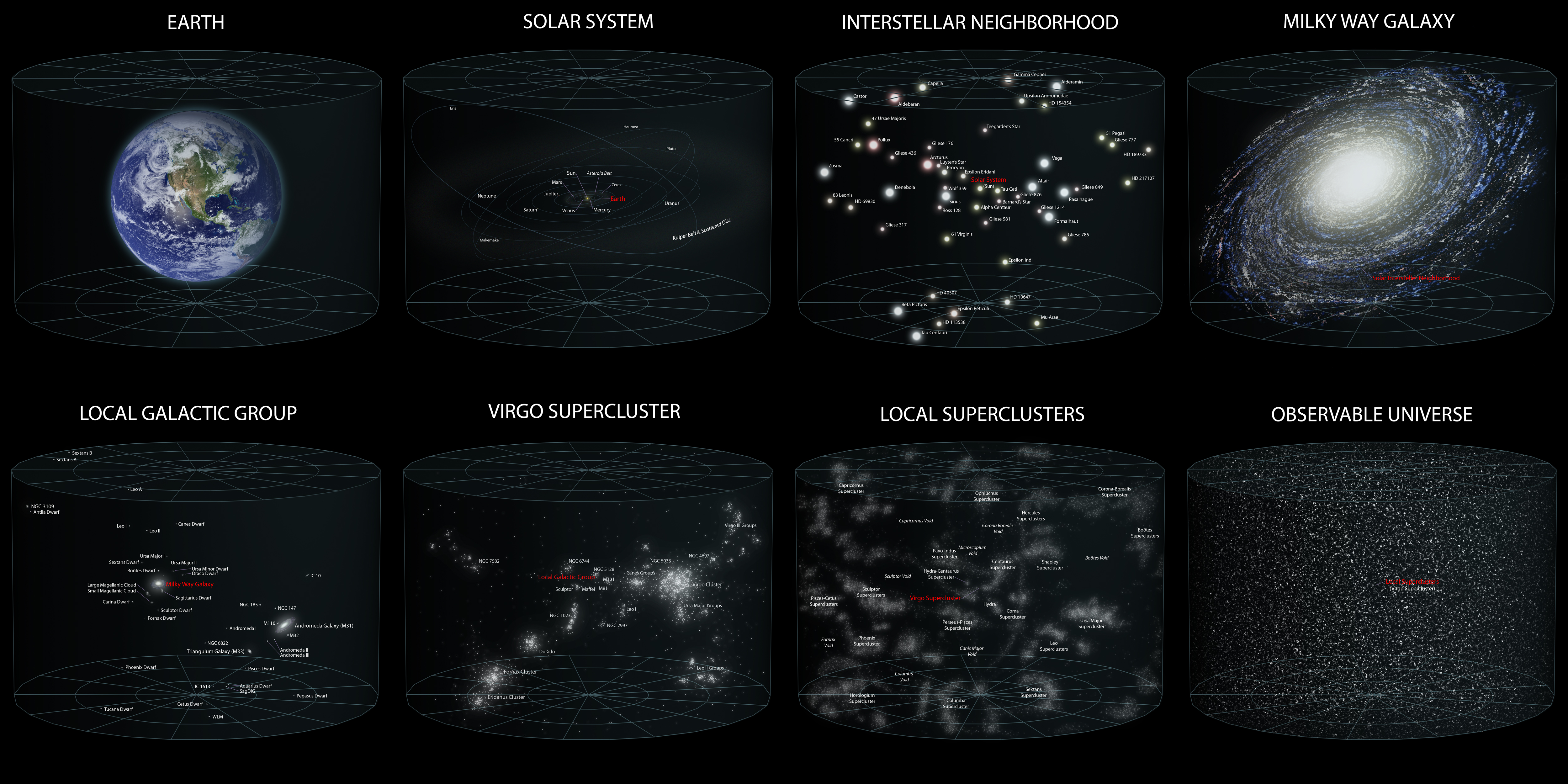
It is from the "Earth" of each, including astrophysics, that the rest of the "Universe" is envisaged -- somewhat presumptuously and arrogantly, as might fruitfully be assumed. Those systems at a great distance are then readily held to be of little significance. They do not matter.
The capacity to envisage "billions" in this way, without any ability to engage with their cognitive significance, recalls concerns regarding the phenomenon of "psychic numbing" in response to tragic disaster affecting millions of individuals -- especially when the suffering is shown to be more systemic and more pervasive. The observer experiences a sense of powerlessness and helplessness -- a sense that nothing in the world will change that particularly broad, complex situation (Paul Slovic, "If I look at the mass I will never act": Psychic numbing and genocide, Judgment and Decision Making, 2007; J. E. Roberston, 'Psychic Numbing': Why does mass suffering induce mass indifference?, 15 August 2010). This is consistent with the distinction between problem assessment and assessment of remedial capacity (Remedial Capacity Indicators Versus Performance Indicators, 1981; Recognizing the Psychosocial Boundaries of Remedial Action, 2009).
In a global knowledge society in which there are many more stars -- even galaxies -- than scientific papers, it is curious that science can claim so assertively to understand the universe, but without being able to factor into such understanding any recognition of its own probable ignorance in the light of what the future may come to learn.
To what extent will the future compare present day configuration of the "stars" of knowledge society, and the relationships between their insights, with early attempts at attributing significance to constellations -- as the perceived patterns formed by prominent stars within apparent proximity to one another? Is the set of citations of any published contribution to the body of knowledge to be understood as such a constellation of significance -- from a particular perspective in knowledge space? Appropriate to this argument, constellations are now defined by international convention -- as with the disciplines of the knowledge universe.
[Parts: First | Prev | Next | Last | All] [Gallery] [Links: To-K | From-K | From-Kx | Refs ]