
Potential systemic implications of configurations of mandala polygons
Con-quest Aesthetically Reframed via the Concordian Mandala (Part #5)
[Parts: First | Prev | Next | Last | All] [Gallery] [Links: To-K | From-K | From-Kx | Refs ]
Nesting: Offering the opportunity of further reflection is the possibility of nesting the Discordian/Concordian Mandala as shown below.
| Nesting of Mandala |
 |
Pentagonal pattern: In highlighting the emergent pentagons, the mandala of nonagons can be further explored in terms of its use in two classical health patterns based on use of the pentagram in Western and Eastern cultures, as discussed previously (Memorable dynamics of living and dying: Hygeia and Wu Xing, 2014; Cycles of enstoning forming mnemonic pentagrams: Hygiea and Wu Xing, 2012):
- Hygiea: The Pythagoreans developed an understanding of health which they associated with the form of the pentagram and the Greek goddess Hygiea (also Hygieia or Hygeia) -- the personification of health, cleanliness and sanitation, and the origin of the term "hygiene" [more]. The name of the goddess is alleged to have been used as their primary greeting (perhaps, speculatively, to be considered an origin for "hug"). The snake encircled Bowl of Hygiea has long been used as one of the symbols of pharmacy. Hygiea Internationalis is now the official journal of the International Network for the History of Public Health.
- Wu Xing: This ancient Chinese mnemonic pattern in the form of a pentagram of five phases, or five elements, is widely known in East Asia. It is traditionally associated with Chinese medicine, acupuncture, feng shui, and Taoism.
The pattern is recognized as highlighting a cyclic relationship between the five constituent elements: fire, earth, metal, water and wood. It is the vectors of the "overcoming" or "controlling" cycle which are typically represented as a pentagram. Generative and destructive cycles are shown as clockwise and counter-clockwise circular motion:
| Hugieia Pentagram of Pythagoreans | Chinese 5-phase Wu Xing cycle |
 | 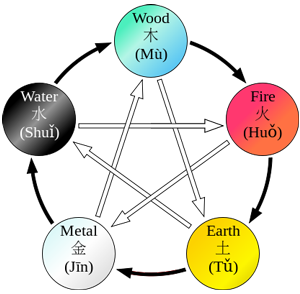 |
| Reproduced from Hygiea entry in Wikipedia (G. J. Allman Greek Geometry From Thales to Euclid, 1889, p.26) with labels added | Adapted from Wu Xing entry in Wikipedia Interaction arrows: black=generating; white= overcoming |
Given the depiction above of 5 interlaced pentagons as being topologically equivalent to the depiction of the Discordian Mandala, the 5 pentagons in the Concordian Mandala can be juxtapositioned in various ways which are potentially of further interest, as illustrated by the following animation.
| Configuration of 5 interlaced pentagons (provisional animation: overlapping not yet coloured correctly) |
 |
Pentagramma Mirificum: Anticipating the discussion below of a 3D variant of the mandala, any quest for a configuration beyond discord can be usefully inspired by the discovery of the geometry of the so-called Pentagramma Mirificum. This originally proved to be fundamental to navigation of the globe, as separately discussed (Global Psychosocial Implication in the Pentagramma Mirificum: Clues from spherical geometry to "getting around" and circumnavigating imaginatively, 2015; Beyond dispute in 5-dimensional space: Pentagramma Mirificum? 2015)
| Pentagramma Mirificum -- a non-regular spherical pentagon | ||
| As sketched by John Napier | Gauss's sketch of Napier's | Adaptation to Wu Xing pattern |
 |  |  |
(Correlating a Requisite Diversity of Metaphorical Patterns: entuning the dynamic of cognitive eases and diseases, 2015) ****
Nonagonal pattern: The pattern of 5 nonagons in the mandala suggests consideration of the mandala in terms of the extensive literature reflecting on the system dynamics framed by the enneagram (A. G. E. Blake, The Intelligent Enneagram, 1996). Such consideration can be extended by the possibilities for its representation in 3D, as discussed separately (Correspondences between Traditional Constellations and Pattern Languages: requisite simplexity for sustainable comprehension of complexity, 2014).
Given that the mandala is composed of 5 nonagons, rather than pentagons, it is also of interest to consider the possibility of an analogous animation -- which may only be possible in 3D.
Especially intriguing is the manner in which their representation in the mandala can be better understood if each nonagon is tilted in 3D such that one edge is in a higher position, and another in a lower position. The 5 higher and 5 lower edges then form two distinct pentagons (by implication) -- one forming the external pentagon and one forming the internal pentagon, with thicker and thinner sides respectively. In 3D the mandala would then frame a kind of bowl in which the nonagons are regular (equal sided) rather than irregular as in the 2D image.
[Parts: First | Prev | Next | Last | All] [Gallery] [Links: To-K | From-K | From-Kx | Refs ]
Subjects: Potential · Symbols, Myths · Form · Systems