
Main menu
You are here
Implied dynamics of the heart symbol -- the "cardiac cycle" otherwise interpreted
Symbolizing Collective Remembering Otherwise (Part #11)
[Parts: First | Prev | Next | Last | All] [Visuals] [Links: To-K | From-K | From-Kx | Refs ]
Whereas little recognition of the ring symbol as such is accorded by politics and economics, much is made of the dynamics of economic cycles. These can be recognized as frozen rings or standing waves. Conversely claims are variously made in rhetorical terms with respect to the "heart of civilization", but with little explicit sense of what this symbolism may imply.
It could be considered remarkably curious that the heart symbol is so widely depicted in static form when the relationships with which it is associated are dynamic -- and typically dramatically so. The cover illustration of the New Philosopher (indicated above) highlights the irony of a static symbol in relation to the dynamics implied by that special issue on What is the meaning of life?
Cardiac arrest? Given the moment-by-moment dynamics of the heart, so essential to the living body in the cardiac cycle, this is even more curious. Framing the symbolic heart in static terms, given the values with which it is associated, could even be considered symbolic of the challenging carelessness of global civilization at this time (Human Values as Strange Attractors, 1993; Freedom, Democracy, Justice: Isolated Nouns or Interwoven Verbs? Illusory quest for qualities and principles dynamically disguised, 2011).
Given the implications of cessation of the dynamics of the heart -- cardiac arrest -- it could even be inferred that there is a perverse investment in an "arrested" heart at a time when there much speculation on the collapse of global civilization through one or other process (Spontaneous Initiation of Armageddon: a heartfelt response to systemic negligence, 2004; Mind Map of Global Civilizational Collapse: why nothing is happening in response to global challenges, 2011).
As with the ring symbol, the argument can be made that the dynamics are necessarily implicit in the static heart symbol, if not elusively so. As noted above, there is then a case for exploring the dynamics in relation to a symbol considered to be so fundamental (From Statics to Dynamics in Sustainable Community, 1998; Dynamic Interrelationship of Symbols of Coherent Experiential Representation of Nonduality, 2008; Dynamic Transformation of Static Reporting of Global Processes, 2013).
Health as a verb? As implied by the cyclic emphasis, whether physical or otherwise, it would indeed seem appropriate that "health" should be understood through a verb -- rather than through a noun or static quality as previously argued with respect to other values (Happiness as a verb -- en-joying as a dynamic? 2011).
The argument is consistent with that relating to the collective health of a society -- as implied by the quest for "sustainability". This could indeed be understood as "collective health" engendered by collective "cognitive health" (Wholth as Sustaining Dynamic of Health and Wealth: cognitive dynamics sustaining the meta-pattern that connects, 2013). Somewhat clumsily, the phrase mens sana in corpore sano could be usefully reframed and inverted as a "healthy global environment within a healthy global knowledge-based society".
Traditional insights: It is appropriate to confront the cyclic phases of the cardiac cycle with insights offered by 5-fold patterns of other cltures and earlier times as shown below (Memorable dynamics of living and dying: Hygeia and Wu Xing, 2014).
| Phases of the cardiac cycle | Hugieia Pentagram of Pythagoreans | Chinese 5-phase Wu Xing cycle |
 |  | 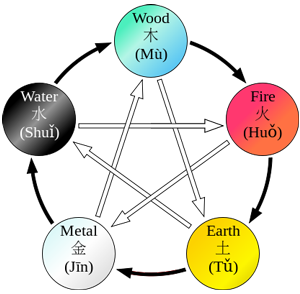 |
| Reproduced from Wikipedia with further details and animations | Reproduced from Hygiea entry in Wikipedia (G. J. Allman Greek Geometry From Thales to Euclid, 1889, p.26) with labels added | Adapted from Wu Xing entry in Wikipedia Interaction arrows: black=generating; white= overcoming |

The two classical health patterns above are based on use of the pentagram in Western and Eastern cultures:
- Hygiea: The Pythagoreans developed an understanding of health which they associated with the form of the pentagram and the Greek goddess Hygiea (also Hygieia or Hygeia) -- the personification of health, cleanliness and sanitation, and the origin of the term "hygiene" [more]. The name of the goddess is alleged to have been used as their primary greeting (perhaps, speculatively, to be considered an origin for "hug"). The snake encircled Bowl of Hygiea has long been used as one of the symbols of pharmacy. Hygiea Internationalis is now the official journal of the International Network for the History of Public Health.
- Wu Xing: This ancient Chinese mnemonic pattern in the form of a pentagram of five phases, or five elements, is widely known in East Asia. It is traditionally associated with Chinese medicine, acupuncture, feng shui, and Taoism. The pattern is recognized as highlighting a cyclic relationship between the five constituent elements: fire, earth, metal, water and wood. It is the vectors of the "overcoming" or "controlling" cycle which are typically represented as a pentagram. Generative and destructive cycles are shown as clockwise and counter-clockwise circular motion:
Perhaps appropriately at this time, it is the Chinese insights into the Wu Xing, expressed in metaphorcial terms, which are of greater relevance in interpreting the psychosocial implications of the implicit dynamics of the heart symbol.
Pumping system: The following table is adapted from the phases identified in the Wikipedia description of that cycle.
| Stage | Atrioventricular valves (tricuspid valve; mitral valve) | Semilunar valves (pulmonary valve; aortic valve) | Status of ventricles and atria; and blood flow | ||
| Diastole (filling) | 1 | Isovolumic relaxation | closed | closed | semilunar (pulmonary and aortic) valves close at end of ejection stage; blood flow stops. |
| 2 | Inflow: a. Ventricular filling b. Ventricular filling with Atrial systole | open | closed | a. ventricles and atria together relax and expand; blood flows to the heart during ventricular and atrial diastole. | |
| b. ventricles relaxed and expanded; atrial contraction (systole) forces blood under pressure into ventricles during ventricular diastole-late. | |||||
| Systole (pumping) | 3 | Isovolumic contraction | closed | closed | Atrioventricular valves valves close at end of ventricular diastole; blood flow stops; ventricles begin to contract. |
| 4 | Ejection: Ventricular ejection | closed | open | ventricles contract (ventricular systole); blood flows from the heart -- to the lungs and to rest of body during venticular ejection. |
As a source of metaphorical insight, a related indication is offered by the thermodynamics of the four phases of the Carnot work cycle described in the following terms:
- Reversible isothermal expansion of the gas at the "hot" temperature (isothermal heat addition or absorption).
- Isentropic (reversible adiabatic) expansion of the gas (isentropic work output).
- Reversible isothermal compression of the gas at the "cold" temperature (isothermal heat rejection)
- Isentropic compression of the gas (isentropic work input).
Given frequent metaphorical reference to the economic "stomach" (Ryan Detrick, Economy strong enough to stomach a trade war, Reuters, 1 March 2018), again it might be asked what equivalent insights are offered by the metaphorical "heart". Again, use is of course frequently made of the "heart of a country" or region, but with little sense of what gets "pumped" and how. A number of cities regularly claim to be "The Heart of Europe", for example. Does this reflect anything more than superficial insight for public relations rhetorical purposes?
Electrical system: It is readily forgotten that the heart is an electrical system and the heartbeat is triggered and sustained by a pattern of electrical signals, as extensively described and illustrated by Wikipedia (Electrical conduction system of the heart). This is expressed otherwise by the Heart Rhythm Society:
First, the atrium contracts. Like a pebble dropped into a pool of water, the electrical signal from the sinus node spreads through the atria. Next, the signal travels to the area that connects the atria with the ventricles, the atrioventricular node (AV node). This electrical connection is critical. Without it, the signal would never reach the ventricles, the major pumping chambers of the heart. As the signal continues and crosses to the ventricles, it passes through another bundle of special electrical tissue called the Bundle of His. The Bundle then divides into thin, wire-like structures called the right and left bundle branches which extend into the right and left ventricles. The electrical signal next travels down the bundle branches to thin electrical fibers. Lastly, these fibers send out the signal to the muscles of the ventricles, causing them to contract and pump blood into the arteries. At rest, in a normal heart, this coordinated series of electrical signals occurs about once every second, maintaining the steady, rhythmic pattern of the heart's beat and causing a normal pulse rate of 60 beats per minute. (Electrical System)
The detailed understanding of this electrical system suggests that it could offer insights into how the dynamics of the psychosocial heart are triggered and sustained -- especially in relation to the necessary feedback loops. The heart could then be usefully understood as a complex of feedback loops. Many songs are specifically entitled "heartbeat", suggesting some intuitive recognition of this process. The metaphor is also used globally (Tracking the World's Economic Heartbeat, World Policy Journal, Summer 2014; The Heartbeat of Social Media, Social Media Today, 26 January 2012; Heartbeat of Social Media, MarketingNutz).
[Parts: First | Prev | Next | Last | All] [Visuals] [Links: To-K | From-K | From-Kx | Refs ]

This work is licensed under a Creative Commons Attribution-NonCommercial 4.0 International License
For further updates on this site, subscribe here