
Cycles of enstoning forming mnemonic pentagrams: Hygiea and Wu Xing
Transforming and Interweaving the Ways of Being Stoned (Part #5)
[Parts: First | Prev | Next | Last | All] [Gallery] [Links: To-K | From-K | From-Kx | Refs ]
Global cognitive health? The question raised by the five clusters (above) of seemingly disparate forms (as described above) is whether they can be fruitfully related in some way -- especially in the quest for what might be understood as "cognitive hygiene" or "conceptual hygiene", capable of encompassing and sustaining global governance. Any such possibility could be formulated in terms of a quest for mnemonic clues, as discussed previously (In Quest of Mnemonic Catalysts -- for comprehension of complex psychosocial dynamics, 2007).
Expressed differently, does the problematic nature of the relationship within and between the five clusters constitute a global public health problem worthy of the preoccupation of global institutions concerned with "health" -- such as the World Health Organization? Does the conflict engendered within and between clusters constitute a challenge to global "health" given the suffering and death it can engender? To what extent are "health" systems currently adapted or indifferent to issues of global cognitive health framed in this way? Beyond "hygiene", does the integrative challenge imply the need for a form of "healing"?
Health represented by a pentagram: Given the understanding of "health" traditionally associated with some form of 5-fold pattern (as with the pentagram discussed below), the question is how this might enable the relationship between the forms of "being stoned" to be fruitfully represented. Particularly interesting is the potential implication that any such "health" needs to be based on some form of cyclic dynamic rather than a static condition.
| Alternative cyclic interrelationship of 5-clusters | |
| Clockwise cycle | Counter-clockwise cycle |
 |  |
It is appropriate to note the considerable significance that tends to be attached to whether circulation is clockwise or counter-clockwise, as evident in widespread commentary regarding the swastika (cf. Swastika as Dynamic Pattern Underlying Psychosocial Power Processes, 2012). These concerns are also evident in commentary regarding any presentation of the pentagram, most notably in inverted forms (as in the variants below). A striking example is the outcome of the ten year legal battle, instigated by Wiccan families, to add the circled pentagram (referred to as a pentacle in the court case) to the list of 38 approved religious symbols to be placed on the tombstones of fallen US military at the US Arlington National Cemetery (cf. Administration Yields on Wiccan Symbol, The Washington Post, 24 April 2007)
The complete set of four forms of competing perspectives then gives rise to dynamics typical of the "rocks" cluster (Annex 3). Together they can be seen as another argument for integrating the cognitive "netherworld", as recognized in Roman and Greek cultures (cf. (Designing Global Self-governance for the Future: patterns of dynamic integration of the netherworld, 2010)
| Alternative variants of inverted pentagram | |
| Clockwise cycle | Counter-clockwise cycle |
 |  Cyclic interrelationship of 5-clusters (counter-clockwise, inverted |
The combination of the above patterns as follows is potentially of significance to a more fundamental understanding of health.
| Decagonal patterns resulting from 5-fold symmetry | |
| Superposition of upright and inverted variants of pentagonal stars (above) | Axial view of DNA (discussed below) |
 |  |
Health as a verb: As implied by the cyclic emphasis, whether physical or otherwise, it would indeed seem appropriate that "health" should be understood through a verb -- rather than through a noun or static quality as previously argued with respect to other values (Freedom, Democracy, Justice: Isolated Nouns or Interwoven Verbs? Illusory quest for qualities and principles dynamically disguised, 2011; Happiness as a verb -- en-joying as a dynamic? 2011).
The argument for recognition of a fundamental dynamic must necessarily recognize the work of psychologist Clare Graves (Human Nature Prepares for a Momentous Leap, The Futurist, April 1974). This formed the basis of a much publicized human development programme -- spiral dynamics -- articulated by Don Beck and Christopher Cowan (Spiral Dynamics: mastering values, leadership, and change, 1996). This has had a significant influence on the Integral Movement through the work of Ken Wilber (A Theory of Everything: an integral vision for business, politics, science and spirituality, 2000). These insights have been further developed by Steve McIntosh (Integral Consciousness and the Future of Evolution, 2007). A summary of their relationship is provided by Alex Burns (About Spiral Dynamics, 2004). Failure to explore such a dynamic may enable a dangerous trap (cf. Psychosocial vortices as self-referential traps, 2010).
The argument is consistent with that relating to the collective health of a society -- as implied by the quest for sustainability. "Sustainability" could indeed be understood as "collective health" engendered by collective "cognitive health". The phrase mens sana in corpore sano could be usefully reframed and inverted as a "healthy global environment within a healthy global knowledge-based society".
Insights from traditional health pentagrams: The relationship between the five clusters (above) can for example be explored further in the light of two classical patterns based on use of the pentagram in Western and Eastern cultures:
- Hygiea: The Pythagoreans developed an understanding of health which they associated with the form of the pentagram and the Greek goddess Hygiea (also Hygieia or Hygeia) -- the personification of health, cleanliness and sanitation, and the origin of the term "hygiene" [more]. The name of the goddess is alleged to have been used as their primary greeting (perhaps, speculatively, to be considered an origin for "hug"). The snake encircled Bowl of Hygiea has long been used as one of the symbols of pharmacy. Within the Roman Empire, Hygiea was called Valetudo and subsequently identified with the ancient Italian goddess of social welfare, Salus. Hygiea Internationalis is now the official journal of the International Network for the History of Public Health.
Much additional commentary is provided under a pseudonym by Apollonius Sophistes (The Pythagorean Pentacle, 1999) who notes that although usually translated as "health," Hygieia has more the sense of soundness or wholeness, and that it comes from the same Indo-European root as "quick" [i.e. living], "viva," "vital," and "bios" [life]. He concludes that the Pythagoreans labeled the Pentagram with the letters (U-G-I-EI-A), sometimes clockwise, sometimes counterclockwise, and either placed on the points starting at the top, or in the angles starting at the top right. This helps to stress the understanding that the orientation of the pentagram calls for understanding in dynamic terms as he notes separately (John Opsopaus The Rotation of the Elements, 1995). He offers the following correspondences:
Pythagorean Hugieia υ (U) Hudor Water γ (G) Gaia Earth ι (I) Idea Form/Idea ει (EI) Heile Heat α (A) Aer Air
Hygiea was held to have had four sisters, also variously associated with health: Panacea (universal remedy), Iaso (recuperation from illness), Aceso (the healing process), and Aglaea (beauty, splendor, glory, magnificence, and adornment).
- Wu Xing: This ancient Chinese mnemonic pattern in the form of a pentagram of five phases, or five elements, is widely known in East Asia. It is traditionally associated with Chinese medicine, acupuncture, feng shui, and Taoism.
The pattern is recognized as highlighting a cyclic relationship between the five constituent elements: fire, earth, metal, water and wood. It is the vectors of the "overcoming" or "controlling" cycle which are typically represented as a pentagram. Generative and destructive cycles are shown as clockwise and counter-clockwise circular motion:- controlling cycle: wood breaks earth, earth absorbs water, water douses fire, fire melts metal, metal splits wood.
- generative cycle: wood feeds fire, fire makes earth, earth bears metal, metal collects water, water nourishes wood.
- destructive cycle: wood absorbs water, water rusts metal, metal breaks earth, earth smothers fire, fire burns wood.
| Hugieia Pentagram of Pythagoreans | Chinese 5-phase Wu Xing cycle |
 | 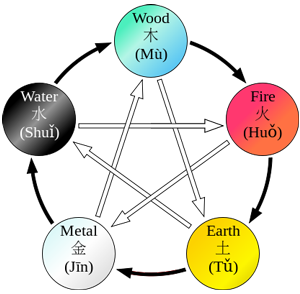 |
| Reproduced from Hygiea entry in Wikipedia (G. J. Allman Greek Geometry From Thales to Euclid, 1889, p.26) with labels added | Adapted from Wu Xing entry in Wikipedia Interaction arrows: black=generating; white= overcoming |
In pointing to the mnemonic potential of these patterns, the purpose is primarily to indicate a suggestive possibility for exploration rather than to highlight a definitive relationship. Juxtaposing fundamental patterns of insight of Eastern and Western cultures might be understood as offering a requisite degree of "polyocular" depth perception (Enhancing the Quality of Knowing through Integration of East-West metaphors, 2000). This is a theme developed by Magoroh Maruyama (Polyocular Vision or Subunderstanding, Organization Studies, 2004).
However, it is appropriate to note with respect to any reliance on a "vision" metaphor that, consistent with the above-mentioned understanding of Hygieia as "soundness", a degree relationship between the two frameworks has been noted through their relevance to tuning systems. According to the Wikipedia entry on Wu Xing, in most modern music, various seven note or five note scales (e.g., the major scale) are defined by selecting seven or five frequencies from the set of twelve semi-tones in the equal tempered tuning. The Chinese "lu" tuning is closest to the ancient Greek tuning of Pythagoras.
One of very few accounts explicitly relating the two traditions is that of Laura Sedgwick (Wu Xing, Hygiea's Bowl, 2010). As mentioned above, the orientations of the two pentagrams needs to be reconciled dynamically.
Cybernetics of cognitive health: Of special relevance to this integration within the context of this argument, further to the work cited above relating to the viable systems model, are the various papers of Maurice Yolles and Zude Ye, whether separately or in collaboration (Cybernetics of Tao, Kybernetes, 2010; From Knowledge Cybernetics to Feng Shui, Proceedings of the 50th Annual Meeting of the IssS, 2006; Knowledge Cybernetics: a metaphor for post-normal science, 2010; Understanding Corruption and Sociopathology, Journal of Organizational Change, 2009; Toward a Formal Theory of Socioculture: a yin-yang information-based theory of social change, Kybernetes, 2008).
The latter is consistent with the valuable summary of A. C. Graham (Yin-Yang and the Nature of Correlative Thinking, 1986) discussed in relation to "correspondences" (Theories of Correspondences -- and potential equivalences between them in correlative thinking, 2007; System Dynamics, Hypercycles and Psychosocial Self-organization: exploration of Chinese correlative understanding, 2010).
Seemingly distinct applications to organization design initiatives are evident from:
- Jay Galbraith in his development from the 1960s of his Star Model ™ framework for analyzing organizations (Designing Organizations, 1995). [see also A. Kates and J. R. Galbraith (Designing Your Organization: using the Star Model to solve five critical design challenges, 2007]
- the development by Tom Graves of a Five Elements model (Needles of Stone, 1986)
The complementary and problematic relationships between the Galbraith and Graves models are the subject of a comment by Tom Graves (The Perils of Prior-Art (Five Elements), Tetradian, 16 June 2011) to the effect that:
In reality, it's not as bad as it seems. I've been using the core Five Elements concepts - adapted from a merge of [Bruce] Tuckman's Group Dynamics and the traditional Chinese Five Elements or wu xing - since well before 1978, when I included a chapter on classic Five Element theory and practice in my second book, Needles of Stone. And although Galbraith's diagram shows various linkages between the nodes of his model, it doesn't seem to indicate any actual dynamics or preferred flow - which the Five Elements model definitely does, in keeping with both Tuckman and wu xing. Not so much 'prior art', then, as useful counterpoints to each other: both models talking about the same kind of space, but in usefully-different ways, having arrived there via somewhat-different routes.
| Star Model ™ of Jay Galbraith (Designing Organizations, 1995) | Five Elements model of Tom Graves (Needles of Stone, 1986) |
 |  |
| Reproduced from Wikipedia entry on organizational architecture | Reproduced from Tom Graves (The Perils of Prior-Art (Five Elements), 16 June 2011) |
Galbraith's model seemingly takes no account of the fivefold Wu Xing pattern. Also ignoring that pattern, a seemingly independent approach is that of Henry Mintzberg (Structure in Fives: designing effective organizations, 1983) based on an earlier work (The Structuring of Organizations, 1979) and usefully reviewed by Thomas Schmidt (A review of Structure in Fives: designing effective organizations, 2006). A sixth feature was later added by Mintzberg. As Schmidt notes:
Throughout the book, Mintzberg notes how the number five is repeated in most of the key aspects. He defines five organizational parts, five coordinating mechanisms and five types of decentralization. Each of these topics contains a set of factors which influences the emerging structure. But as Mintzberg notes before starting to define the 5 key structures: There is no dependent or independent variable in a system, everything depends on something else.
[Parts: First | Prev | Next | Last | All] [Gallery] [Links: To-K | From-K | From-Kx | Refs ]