
Comprehension of requisite symbolic coherence of viable development goals
Imagining Partnership of the SDG Goals as Phases of the Cross (Part #8)
[Parts: First | Prev | Next | Last | All] [Gallery] [Links: To-K | From-K | From-Kx | Refs ]
Secular symbolism: Formal academic studies typically deprecate the value of symbolism and the coherence it is claimed to offer -- despite frequent recourse to "symbols" and their value in distinguishing academic achievement. Governmental authorities echo this secular bias -- except when faced with the challenge of communication to the wider population through flags and otherwise (Symbolic Insignia Indicative of Global Health, 2021). The questionable role of the Anthem of Europe in this period offers an interesting exception (Reversing the Anthem of Europe to Signal Distress, 2016).
The United Nations could be held to be relatively -- if not systematically -- uncreative in exploring the integrative symbolism capable of enabling credible sustainable development. The business community is particularly attentive to symbolic representation through development of distinctive logos -- most notably in the case of multinational corporations. A compilation of international logos framing global strategic preoccupations has been provided by the Union of International Associations (World Guide to Logotypes, Emblems and Trademarks of International Organizations, 1997).
Religious symbolism: A contrast is evident in the case of religions for which symbolism is upheld to be of importance -- if not of extreme importance with respect to the salvation of individuals and humanity. Somewhat ironically the various symbols are notably used in defensive encounters of one religion with another, with no effort whatsoever to reconcile the disparate perspectives with which they are respectively associated. The point is emphasized in experimental speculation in this regard (Reconciling Symbols of Islam, Judaism and Christianity, 2017; Middle East Peace Potential through Dynamics in Spherical Geometry, 2012; Jerusalem as a Symbolic Singularity, 2017).
In symbolizing, through their fundamental disparity, the fragmentation which characterizes global civilization, religions have much to answer for -- or do they? (Stephen Prothero, God Is Not One: the eight rival religions that run the world -- and why their differences matter, 2010). Despite multiplication of interfaith initiatives, their inadequacies are evident in the valuable insights of the Secretary General of Religions for Peace (Azza Karam, COP27: Religious Multilateralism: an endangered species in the age of triple planetary crises, Inter Press Service, November 2022). The point can be more provocatively made with respect to the Abrahamic religions (Root Irresponsibility for Major World Problems, 2007).
Curiously missing from the posture of religions in interfaith discourse is the immense importance they traditionally associate with configurations framed by specific numbers -- and the opportunities these offer for a degree of reconciliation through patterns of numbers and sacred geometry. The opportunities are faintly recognized in terms of mathematical theology, as described separately (Mathematical Theology: future science of confidence in belief, 2011). This perspective does not appear to evoke reflection of religions on the 16- or 17-fold patterns of the SDGs -- upheld as so fundamental to viable governance of global civilization. Is there any expectation that this would be otherwise in the case of the 22-fold or 23-fold patterns of the IDGs? This is despite the extensive Wikipedia summaries regarding the symbolic significance of the numbers: 16, 17, 22, and 23 -- if only for some religions.
Quest for strategic coherence through N-foldness? As exemplified by the case of the IDGs, it would appear that collective articulation of strategic frameworks is accompanied by a cognitive struggle for coherence which is resolved through convergence on particular number-governed patterns, as noted separately (Checklist of 12-fold Principles, Plans, Symbols and Concepts: web resources, 2011; Checklist of web resources on 20 strategies, rules, methods and insights, 2018). The SDG and IDG patterns are unusual in this respect -- perhaps due to accumulating recognition of the inadequacies of those more commonly favoured.
In the absence of explanations as to why there is convergence on particular N-fold patterns -- deemed satisfactory in their coherence -- there is a case for recognizing them as the process whereby holons are constructed. For Arthur Koestler, as formulator of the concept, a holon is something that has integrity and identity while simultaneously being a part of a larger system; it is a subsystem of a greater system (The Ghost in the Machine, 1967). The reference to "part" is of some relevance to the consideration of "partnership for the goals" as the 17th SDG. Given Fuller's understanding of polyhedra (cited above), the construction of a strategic array is effectively the construction of a holon, which as a polyhedron is necessarily part of a larger array of polyhedra.
Exemplifying strategic articulation of the highest order, it is appropriate to note the unexplained preferences for particular patterns in recent reports sponsored by the Club of Rome (Ernst von Weizsaecker and Anders Wijkman, Come On! Capitalism, Short-termism, Population and the Destruction of the Planet, Springer, 2018; Sandrine Dixson-Declève, et al, Earth for All: a survival guide to humanity, 2022). The former appears to favour a 40-fold articulation (in clusters of 10, 12 and 18), as variously mapped and discussed separately (Exhortation to We the Peoples from the Club of Rome, 2019).
The Earth4All initiative embodies an unexplained preference for the use of four in the variant of its name, although it specifically builds on previous studies of the 9 planetary boundaries distinguished by the Stockolm Resilience Centre. The latter framing could be understood to derive from the extensive significance of nine in Norse mythology, most notably the nine worlds that are supported by Yggdrasil as the "World Tree" (Joshua J. Markby, Nine Realms of Norse Cosmology, Ancient History Encyclopedia, 20 December 2018). The implications are discussed and visualized separately (Aesthetic reconciliation of contrasting toroidal metaphors? 2019; Recognizing the Psychosocial Boundaries of Remedial Action: constraints on ensuring a safe operating space for humanity, 2009)
Other than as a useful play on words for branding purposes, and its conception by four primary authors, the "four" of Earth4All seems to derive from recognition that it is the "fourth scenario" of the recent global modelling on which it is based -- and the only pathway to a viable future now deemed desirable (Jayati Ghosh, Achieving Earth for All, Earth4All, 22 July 2022)
A radically contrasting perspective on another "fourth scenario" is offered by Sabbah Uddin (The Fourth Scenario, The Daily Times, 29 January 2020). This comments on a report of the US National Intelligence Council 2020 Project (Mapping the Global Future, 2004). This explored four fictional scenarios regarding what was thought to be a reasonable forecast, giving an excellent overview of expert conventional wisdom on the major trends shaping global politics and economics. These were labelled: Davos World, Pax-Americana, A New Caliphate, and the Cycle of Fear. The latter was seen as a reign of terror produced by the underworld helping ideologically motivated Muslim groups to use a WMD of nuclear or biological catastrophe in Europe, America, Middle East or Asia. Of potential relevance as a metaphor, another perspective is offered by Ross Douthat with respect to the future of marriage (A Fourth Scenario, The Atlantic, 30 September 2008).
As with the IDG framework, the Earth4All framework favours a fundamental 5-fold strategic pattern. Curiously the "healthy" coherence of a 5-fold framework is traditionally esteemed in both Western and Eastern cultures, as Hygieia and Wuxing (Memorable dynamics of living and dying: Hygeia and Wu Xing, 2014). Is the preference for such strategic frameworks in multiple domains indicative of a more fundamental pattern -- one which remains a challenge to articulation and comprehension across disciplines? Given the arguments above relating to the 4-fold tetrahedron, the systemic challenges of interrelating 4-fold and 5-fold merit consideration, given the corresponding integrative role associated with quaternity (Quaternity, quaternions and the unifying goal of partnership? 2022).
Reconciling contrasting strategic frameworks: Curiously unexplored are the systemic equivalences between 5-fold articulations of the strategic challenge, as with that of the Global Government Forum (The Five Principles of Strategic Communication). Other examples are presented below of which the most articulated is that of the Viable System Model, originally developed by Stafford Beer (Platform for Change, 1975).
| Variants of an unexplored 5-fold strategic pattern language? | ||||
| 5 Turnarounds of Earth4All to create wellbeing for all | 5 Dimensions of Inner Development Goals | Viable System Model | Chinese 5-phase Wu Xing cycle | Hugieia Pentagram of Pythagoreans |
 |  |  | 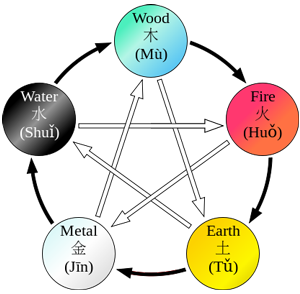 |  |
| As articulated by Stafford Beer | Adapted from Wu Xing entry in Wikipedia | Reproduced from Hygiea in Wikipedia | ||
The difficulty at this time is less than the recognition of a fundamental 5-fold pattern, embodied in an exemplary manner by the Five Pillars of Islam. The challenge with any 5-fold pattern, as with any preferred N-fold pattern, is the apparently incommensurable ways in which it is perceived (Interrelating Multiple Ways of Looking at a Crisis: beyond the pandemic discipline of the one right way, 2021). A case can be made for recognizing that reconciliation between groups favouring contrasting N-fold patterns -- understood as offering coherence and global closure -- could be fruitfully explored in terms of more complex patterns.
With respect to any 5-fold pattern, for example, the table below suggests the possibility of coherent reconciliation of 4 contrasting understandings of such a pattern in a 20-fold polyhedral pattern (4x5), or of reconciling 6 contrasting understandings of it in a 30-fold pattern (5x6). However 3, 5, 7, 8 or 9 contrasting understandings of a 5-fold pattern could not be coherently represented in Platonic or Archimedean polyhedra.
| Indication of polyhedral patterns through which incommensurable N-fold patterns may be reconciled (coherent reconciliation restricted here to the global symmetry of Platonic and Archimedean solids indicated by letters below) | ||||||||
| 2 | 3 | 4 | 5 | 6 | 7 | 8 | 9 | |
| 2 | 4-fold (a) | 6-fold (a,b) | 8-fold (b,c,f) | 10-fold | 12-fold (b,c,d,e,f,g) | 14-fold (g,h,j) | 16-fold | 18-fold (f) |
| 3 | 6-fold (a,b) | 9-fold | 12-fold (b,c,d,e,f,g) | 15-fold | 18-fold (f) | 21-fold | 24-fold (h,j) | 27-fold |
| 4 | 8-fold (b,c,f) | 12-fold (b,c,d,e,f,g) | 16-fold | 20-fold (d,e) | 24-fold (g,k,n) | 28-fold | 32-fold (p,q,r) | 36-fold (h,j) |
| 5 | 10-fold | 15-fold | 20-fold (d,e) | 25-fold | 30-fold (d,e,p) | 35-fold | 40-fold | 45-fold |
| 6 | 12-fold (b,c,d) | 18-fold (f) | 24-fold (g,j,k,n) | 30-fold (d,e,p) | 36-fold (h,j) | 42-fold | 48-fold (k,m) | 54-fold |
| 7 | 14-fold (g,h,j) | 21-fold | 28-fold | 35-fold | 42-fold | 49-fold | 56-fold | 63-fold |
| 8 | 16-fold | 24-fold (h) | 32-fold (p,q,r) | 40-fold | 48-fold (k,m) | 56-fold | 64-fold | 72-fold (m) |
| 9 | 18-fold (f) | 27-fold | 36-fold (h,j) | 45-fold | 54-fold | 63-fold | 72-fold (m) | 81-fold |
| Regular and semi-regular polyhedra offering features with which N-fold patterns might be associated (letters correspond to the patterns in the table above; numbers to unused patterns above) | ||
| Platonic solids | Archimedean solids | |
|
|
|
Especially interesting is the impossibility of representing simply 2 contrasting understandings of a 5-fold pattern in any of those polyhedra. It is of course the case that other polyhedra, deemed memorably comprehensible from their symmetries, could be used, as discussed separately (Identifying Polyhedra Enabling Memorable Strategic Mapping, 2020). Significantly missing from any 2-factor reconciliation challenge is a 60-fold pattern which would only become relevant with 3 factors or patterns of larger size (eg 3x4x5, or 5x12, or 4x15, or 3x20). There are then several 60-fold mapping possibilities indicated above.
It is also the case that various "tricks" can be used by consideration of axes or totalling sides, vertices and edges of a polyhedron. Thus a tetrahedron (4 sides, 6 edges, 4 vertices) could be used to represent a 14-fold articulation. Perhaps surprisingly, 14 shares with 8 and 32 in being the most common number in that respect (among the Platonic polyhedra), occurring 4 times, even greater than that of 12. As discussed below, this could suggest that the SDGs might be more appropriately memorable if they were a pattern of 14 rather than of 16. A set of 14 SDGs could be completely represented on a single tetrahedron, with the "17th Goal" then associated with the centroid as the "15th". On the other hand, if each of the 4 vertices of a tetrahedron -- as the conjunction of 3 edges -- were to be considered as a "4-fold nexus", each such nexus could be associated with a cluster of 4 of a 16-fold pattern of SDGs.
Clearly the concern here is how contrasting understandings of a 16-fold pattern of SDGs might be represented in order to reconcile them, as discussed previously (Polyhedral representation of Sustainable Development Goals including "Own Goals"? 2022). The latter explored the value of encompassing the 16 Goals in a 32-fold pattern -- namely together with a critical perspective on their achievement in practice, or failure in that respect -- namely the "shadow" SDGs, otherwise negelected.
Recognition of an array of patterning possibilities frames the potential for shfting between them -- along transformational pathways, as presented separately (Changing Patterns using Transformation Pathways, 2015; Pathway "route maps" of potential psychosocial transformation? 2015)
Remedial proposals? In preparation for COP27, the United Nations Environment Programme asserts that the international community is falling far short of the Paris goals, with "no credible pathway" to 1.5°C (Emissions Gap Report 2022: The Closing Window – Climate crisis calls for rapid transformation of societies, October 2022):
Policies currently in place point to a 2.8°C temperature rise by the end of the century. Implementation of the current pledges will only reduce this to a 2.4-2.6°C temperature rise by the end of the century, for conditional and unconditional pledges respectively.
The report argues that only an urgent system-wide transformation can avoid climate disaster. Thomas Homer-Dixon and Johan Rockström take the systemic argument further (What Happens When a Cascade of Crises Collide? New York Times, 13 November 2022):
In reality, the likelihood that the current mess is a coincidence is vanishingly small. We're almost certainly confronting something far more persistent and dangerous. We can see the crises of the moment, but we're substantially blind to the hidden processes by which those crises worsen one another — and to the true dangers that may be enveloping us all.
Today's mess is better understood as a global polycrisis... The term implies that humanity is dealing with a complex knot of seemingly distinct but actually deeply entangled crises. Precisely because these crises are so entangled, they're causing worldwide damage much greater than the sum of their individual harms. In the last 10 years, things have gone fundamentally awry.
The authors conclude:
We propose a worldwide scientific collaboration to identify the causal mechanisms operating among these risks. This collaboration would consist of a global consortium of nationally funded institutes. It would be dedicated, first, to studying mechanisms that are amplifying, accelerating and synchronizing global systemic risks and, second, to determining practical ways humanity might intervene. It would also look for ways these feedbacks might be harnessed to tip key economic, social, and ecological systems toward better outcomes.
Unfortunately the proposal itself exemplifies the problematic response of acclaimed expertise and the many hundreds of think tanks to which it gives rise, as discussed separately (Tank Warfare Challenges for Global Governance: extending the "think tank" metaphor to include other cognitive modalities, 2019). This fails to address the fundamental issue implied by the UNEP assertion that there is no credible pathway. What is to be understood by "credible" and for whom?
[Parts: First | Prev | Next | Last | All] [Gallery] [Links: To-K | From-K | From-Kx | Refs ]
Subjects: Vulnerability · Development · Policy · Symbols, Myths · Integration · Comprehension