
Symbolic configuration of disparate strategic elements?
Cognitive Engagement with Spike Dynamics of a Polyhedral Coronavirus (Part #7)
[Parts: First | Prev | Next | Last | All] [Gallery] [Links: To-K | Refs ]
In a section on Global connectivity as reinforced through symbolic configuration? in the previous paper, the recognized value of symbols in holding patterns of much-valued insights was noted. The question was raised regarding the requisite complexity at this time of a global configuration appropriate to the challenges of a civilization in crisis. Given the sense of a multifold crisis, seemingly simplified by the singular nature of the coronavirus pandemic, the use of the form of that virus as a clue to more complex configurations is arguable appropriate -- if only as a challenge to reflection.
By how many elements is it appropriate to assume that the global crisis is characterized at this time? The UN found it appropriate to shift from the 8-fold set of Millennium Development Goals (2000) to a 16(+1) fold set of Sustainable Development Goals (2016). Other reputable reports have proposed 14, 15, 16 and the like.***. None of these is organized in systemic terms, such as to highlight the interrelationships between their elements -- or to explain how different groups could favour different configurations, thereby undermining emergence of the global strategic coherence to which they each purport to aspire. Can it honestly be claimed that these articulations of strategic insight are adequate in a period of crisis with whose emergence the thinking they embody has been associated?
As a provocation, however controversial, there is therefore a case for exploring traditional configurations, which dare to imagine the need for higher numbers of focal preoccupations -- and which seek ways to render their configurations coherent and memorable. As noted above, the range of potential connotations of value, mathematical and otherwise, is usefully suggested Wikipedia (72 (number))
Traditional "Western" configuration: Any such pattern of coherence lends itself to further speculative exploration (Engaging with Hyperreality through Demonique and Angelique? Mnemonic clues to global governance from mathematical theology and hyperbolic tessellation, 2016). The following was developed from an argument there regarding an experiment in Hyperbolic reframing of the Demonique and Angelique of tradition. This has the merit of reflecting the qualitative distinctions in a pattern of 72, whereas the global configurations of spikes above only do so in terms of their geometrical orientation around the sphere.
The contrasting patterns help to frame reflection on whether the values, aspirations and strategies of humanity can be understood as encoded in the extensive reflection on a configuration of "angels" -- as noted in the discussiion giving rise to themapping. The "demons" to which they are opposed could be similarly seen as represented a corresponding configuration of sigils by which the "demonic forces" are understood to be bound or held in check. Modern termoinologhy would of course prefer a more neutral reference to "positive" and "negative" respectively -- although remarkably unwilling to articular the variety of positive or negatives forces from a strategic perspective.
| Indication in 2D of the dynamic nature of a "hyperdimensional" crown-corona Alternative experimental configurations alternating between the 72 angels and demons | |
| Animation of 8 sets of 9 (enlargements for detail: angels / demons) | Animation of 9 sets of 8 (enlargements for detail: angels / demons) |
 |  |
| The allocation of sets to the star "tables" in the above schematics is based on the tabular form in which the 72 angel names (from the Shemhamphorasch) and the72 demonic sigils (from the Ars Goetia) are typically presented. The rows are presented "around the tables" in one schematic, and the columns are presented "around the tables" in the other. The sequence around the tables is questionable, demanding further consideration. | |


The question is how those configurations might be rendered comprehensible otherwise, inspired by the polyhedral form of the coronavirus --with its implications for systemic ordering vital to its integrity. The approach explored below for the model is to increase the width of the spikes and to place the symbols above on the ends, as shown below. .
| Indication in 3D of the dynamic nature of a "hyperdimensional" crown-corona | |||
| 3D Configuration of "positive forces " as 72 "Angel names" | 3D Configuration of "negative forces " as 72 "Demonic sigils" | ||
 |  |  |  |
Traditional "Eastern" configuration: Of corresponding relevance is the articulation of Chinese culture in the 64-fold pattern of hexagrams of the I Ching. An earlier circular configuration in 2D confirmed the reflection of Gottfried Leibniz in inventing the binary coding system in 1689 -- now so fundamental to computing.
As presented on the right below, particular transformations between conditions of change, as denoted by the hexagrams, are indicated according to that coding system. Interpretative descriptions of each are provided separately. As a pattern indicative of a dynamic understanding of unity, it lends itself to experimental animations, as described separately (Dynamic Exploration of Value Configurations: interrelating traditional cultural symbols through animation, 2008). One variant is accessible in video format (Relating cultural symbols using dynamic I Ching configuration, YouTube).
| Examples of circular configurations of 64 I Ching hexagrams | |
| As communicated to Leibniz (1703) | Indicating transformations between conditions |
 | 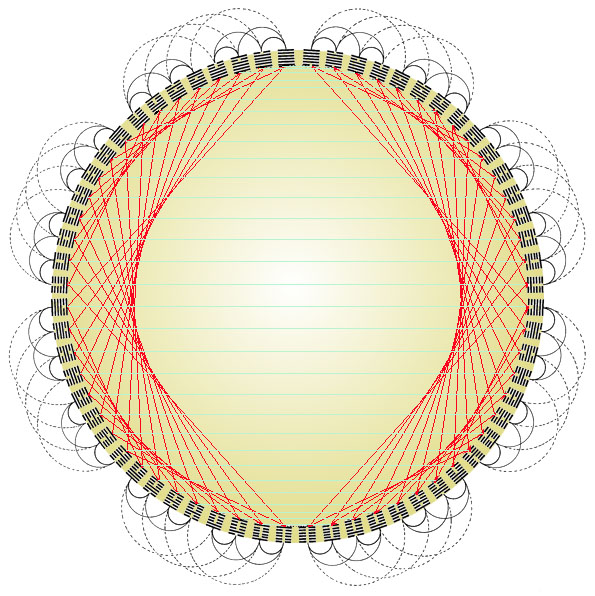 |
| By Unknown - Perkins, Franklin. Leibniz and China: a commerce of light. Cambridge UP, 2004. 117., Public Domain, Link | As used on this website, for which it was elaborated; further details of the configuration are provided separately |
Of relevance to the polyhedral approach adovcated here, the question is whether any such mapping can be fruitfully configured in 3D, as discussed separately (Proof of concept: use of drilled truncated cube as a mapping framework for 64 elements, 2015)
The pattern of 64 is nearly unique within that polyhedral context. However one interesting candidate is the toroidal drilled truncated cube with 64 edges -- with which any set of 64 elements could be associated. The issue is whether the manner in which they can be positioned on that framework constitutes a configuration which is meaningful in relation to particular cases, such as the codons or the hexagrams. Furthermore, is it possible that known constraints in the patterning in such particular cases can together offer guidance in the attribution of the distinct elements -- of relevance to each case?
Preliminary experiments with this polyhedron have been undertaken previously with respect to the hexagrams alone -- but only to get a sense of the possibility, as a "proof of concept" (Enabling Wisdom Dynamically within Intertwined Tori: Requisite resonance in global knowledge architecture, 2012). To be emphasized is the degree to which the Chinese codiing system is complemented by a detailed pattern of metaphors through which distinctions between the 64 elements are made, as well as the meaning which can be associated between the transformations between them -- inviting a variety of patterns of interpretation of relevance to governance (Transformation Metaphors derived experimentally from the Chinese Book of Changes (I Ching) for sustainable dialogue, vision, conferencing, policy, network, community and lifestyle, 1997). Again it should be emphasized that no comparable patterns have been articulated in memorable terms between the elements of sets of global strategies.
Drilled truncated cube of 64 edges with random attribution of hexagram names | |
| Selected faces transparent | All faces transparent |
 |  |
| Animations generated with Stella Polyhedron Navigator | |
Possible use of this form as a means of interrelating genetic codons is illustrated by the following.
| Drilled truncated cube of 64 edges with random attribution of codon combinations | |
| Animation with faces non-transparent | Animation with faces transparent |
 |  |
| Animations generated with Stella Polyhedron Navigator | |
The juxtaposition above immediately raises the questions:
- how best to assign the elements into significant patterns in both cases
- whether mapping assignments in one case offer guidance and constraints for the other
- which of the preliminary assumptions made below should be called into question
- whether assignments could be better considered as dynamic rather than static (as suggested by resonance, and discussed below)
Illustration of geometric model changing between two possible capsids. A similar change of size has been observed as the result of a single amino-acid mutation ***
[Parts: First | Prev | Next | Last | All] [Gallery] [Links: To-K | Refs ]