
Envisioning consensus and synthesis: what form might it take?
Multi-option Technical Facilitation of Public Debate (Part #7)
[Parts: First | Prev | Next | Last | All] [Gallery] [Links: To-K | From-K | From-Kx | Refs ]
Whether in people's assemblies in general (involving hundreds of people), or the French case (potentially involving millions), it remains quite unclear as to what form any expression of consensus might take.
Lists: Most conventionally it could take the form of a list of issues, sifted from lists articulated in smaller groups. In the French case such lists from debates facilitated by 36,000 mayors, would first be sifted at the regional level, then at the national level by a process which has yet to be clarified. Presumably the final product would take the form of a list of 20 to 100 points. There are many examples of such actionable lists, most notably those of the United Nations, as with its Sustainable Development Goals. or Agenda 21 (potentially backed by extensive detail). One example is the recent report to the Club of Rome (Ernst von Weizsaecker and Anders Wijkman, Come On! Capitalism, Short-termism, Population and the Destruction of the Planet, 2018).
With respect to the national socio-political crisis associated with the uprising of the Gilets Jaunes, President Emmanuel Macron took the highly unusual measure of addressing a "Letter to the French" (Lettre au Francais, 13 January 2019). This presents a list of questions under 4 headings by which the Grand Débat has been framed (Les 32 questions d'Emmanuel Macron dans sa lettre qui lance le grand dÉbat national, La Tribune, 13 January 2019; Grand dÉbat: les 33 questions suggÉrÉes par Emmanuel Macron, Le Figaro, 14 January 2019; Lettre aux FranÇais: les 35 questions posÉes par le prÉsident, Le Progres, 14 January 2019),
As indicated by these articles, there is some difficulty in giving a precise count of the number of questions because of the structure of the letter, the manner in which they are posed, and the manner in which some are effectively "follow-on" questions, readily combined with another. Other than being clustered under 4 headings, no systemic relations are indicated between them, even though obvious solutions to one could be incompatible with that of another, just as some complement one another in other ways..
Issue maps: Typically such lists avoid indication of the systemic (and budgetary) relations between issues -- which are necessarily a preoccupation in determining budgetary priorities. The approach for the Club of Rome has been explicitly criticized for inadequacies in that respect (Exhortation to We the Peoples from the Club of Rome, 2018).
A valuable demonstration of this approach are the diagrams presented in a paper to the 34th International Conference of the System Dynamics Society (Bramka Jafno, Pedram Soltani and Erisk Pruyt, Saving Lives and Time: Tackling Transportation Induced Air Pollution in Jakarta, 2016).
| Issue maps indicating systemic relations between issues | |
| Simplified stock and flow diagram | Highly aggregated causal loop diagram |
 |  |
| Images reproduced from Saving Lives and Time: Tackling Transportation Induced Air Pollution in Jakarta (2016) | |
The paper by Bramka Jafno and colleagues (2016) uses a "bull's eye" diagram (below left) to frame a particular focus in relation to more contextual issues. In an interactive context, any such "eye" could be moved from one focus held up as a priority to another, as a kind of magnifying lens -- in each case pushing other issues (then understood as secondary) to the perimeter.
The "Bull's Eye" framing has a potentially interesting relationship to the "Eye of Horus" (below right), especially since the latter was held to offer symbolic oversight of significance to governance. Like the Bull's Eye, it can be understood as of relevance to providing a context for a complex set of viewpoints, as previously argued (Interrelating Viewpoints in Complex Meetings the Horus wall-display technique, 1978). Given the argument below for an aesthetic configrution of issues, the proportions associated with the Eye of Horus (indicated below) offer further mapping possibilities.
| Display alternatives | ||
| Bull's Eye diagram | Eye of Horus diagram | |
 |  | |
 | 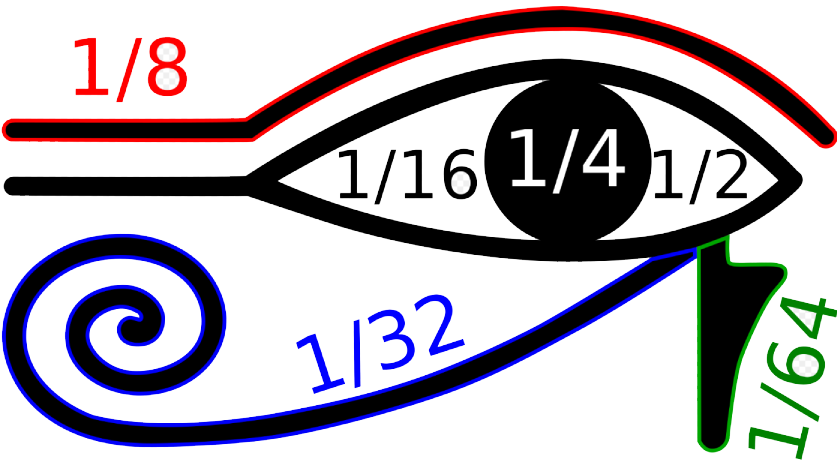 | |
| Image from Saving Lives and Time: Tackling Transportation Induced Air Pollution in Jakarta (2016) | Lower images reproduced from Wikipedia | |
More ambitiously, software could be used to indicate relations between issues raised so that the articulation of points could take the form of what would look more like a map -- readily printed, projected onto screens, or disseminated via the web. The development of such possibilities is a preoccupation of the Global Sensemaking network. This explores tools for dialogue and deliberation on so-called wicked problems.
Given the development of mind mapping techniques, as noted above, the outcome of a complex conference can be presented in a form such as the following, where the consensus is with regard to the configuration as a whole, rather than with any particular part.
| Mind maps | |
| Mind map indicative of the consensus of debate | Concept map of UN's Climate Change Agreement |
 |  |
| By M.U.Paily - Own work, CC BY-SA 4.0, Link | Generated by Leximancer from draft agreement text |
A notable example of text analysis software to this end is Leximancer, as applied experimentally in 2009 in anticipation of a UN Climate Change Agreement (Concept Analysis of Climate Change Agreements, 2009). This automatically analyses text documents to identify the high level concepts, delivering the key ideas and actionable insights that are needed with powerful interactive visualizations and data exports. This enables interactive thematic and concept maps to be rapidly produced for the range of topics evoked in a mass of communications. As was done in that experiment, an automated report can be generated by Leximancer to highlught the concepts detected.
Trends: Another approach is evident in that which Google Trends has made available. It is notable that the media giants have long made controversial use of "profiling" as a means of eliciting advertising income. They may well sell profile data to enable advertisers to use data mining techniques, as illustrated by the Facebook-Cambrige Analytica data scandal. Such techniques can be readily adapted to process citizen comments submitted anonymously.
There is every reason to believe that this already done in some manner by security services. For such reasons it is appropriate to address the concerns voiced by some Gilets Jaunes that the intentions of the French authorities in electing opinions from the population may well not be all that they are overtly claimed to be. The process calls for a degree of transparency which the authorities are typically called upon to employ with respect to electoral voting procedures.
3D Configurations: At a time when much is being made (notably in France) of the possibilities of virtual reality in a knowledge-based civilization, configuration of more complex interactive maps in 3D is a possibility which could invite the engagement of those who make regular use of social media -- as an extension of that facility.
These contrasting possibilities frame the question as to consensus can be articulated and to what degree -- and how the processes of governance can engage with any such articulation. Dependence on lists as conventionally preferred, is potentially an indication of an obsolete framing of governance which is no longer "fit for purpose". Especially relevant is the possibility of holding the dynamic between contrasting or incommensurable priorities -- by which governance is typically faced, if only from a budgetary perspective.
Comprehension of the connectivity for appropriate consensus is arguably enabled by emerging technology in which Frances claims particular expertise:
- Visualization Enabling Integrative Conference Comprehension: global articulation of future-oriented 3D technology, (2018)
- Time for Provocative Mnemonic Aids to Systemic Connectivity? Possibilities of reconciling the "headless hearts" to the "heartless heads" (2018)
Indications of future possibilities include visualizations of the Global Brain, those of the human brain, and a metabolic network, as shown below. Analogous images of biodiversity would be indicative of the coherence of the global ecosystem.
| Future display possibilities | ||
| 3D view of Simulated Thalamocortical Brain Network | Example of metabolic network | Internet connectivity -- the "Global brain" |
 |  |  |
| Screen shot of video by Ivan Dimkovic (2012) | Lemke, et al. (2004) | Map of the internet by Karel Donik of The Opte Project (2015) |
The images above raise the question as to how the strategic coherence emerging from a national or international debate on a comprehensive range of issues might be usefully visualized. As noted above, the online Encyclopedia of World Problems and Human Potential makes available a multitude of maps visualizing hierarchical and systemic relations between problems and between strategic solutions. Exploration of the data using the NetMap Analytics application has given rise to interactive images such as the following.
| Indication of use of an interactive application explore systemic relations between strategies and problems | |||
| Study of Energy Strategies (represents 1472 strategies and 4790 links; click on image for larger version) | Strategies responding to Violence (emergent groups and details) (represents 2367 strategies and 6740 links; ; click on image for larger version) ) | ||
 |  |  |  |
| Images reproduced from Preliminary NetMap Studies of Databases on Questions, World Problems, Global Strategies, and Values (2006) | |||
Aesthetic articulations: The images in the media coverage of the Gilets Jaunes uprising in Paris have been striking. A notable example is provided by a wall fresco made by Pascal Boyart, a street artist supporter of the movement.
| Gilets Jaunes fresco on a Paris wall by Pascal Boyart inspired by a painting of Marianne by Eugène Delacroix (Liberty Leading the People, 1830) |
 |
| AFP: Reproduced in Liberation (8 January 2019) and La Croix (8 January 2019) |
Such imagery raises the question as to whether any consensus from the Grand Débat could take the form of images (other than concept maps), poems or songs. Does the French uprising call for an equivalent to Picasso's Guernica -- or a gallery of Guernicas?
Is it possible that poems and songs could articulate a complex pattern of insights in ways which a greater proportion of the population would find meaningful? The argument has been developed separately (A Singable Earth Charter, EU Constitution or Global Ethic? 2006; Ensuring Strategic Resilience through Haiku Patterns, 2006; Participative Development Process for Singable Declarations Applying the Wikipedia-Wikimedia-WikiMusic concept to constitutions, 2006).
Will a "Gilets Jaunes song" emerge to elicit a degree of consensus in France? Perhaps more thn ironically, at the time of the launch of the Grand Débat, a competition is being organized in France to determine who is to represent France at the forthcoming Eurovision Song Contest (14 May 2019) -- immediately prior to the elections for the European Parliament.
Could the challenges of climate change and any "ecological transition" be fruitfully articulated in that mode? Of particular value would be the capacity to convert lengthy debate into more attractive aesthetic forms as a catalyst for engagement and consensus, as separately discussed (Convertor from Text to Poetry, Song or Music: computer-assisted aesthetic enhancement of treaties, declarations and agreements, 2007). The development of automatic text-to-poetry conversion offers the provocative possibility that Macron's 30-plus questions to the French (as noted below) could be converted experimentally into poetic form in order to increase, through aesthetics, the memorability of the integrative pattern of systemic relationships they purportedly constitute. Indicative examples include Automated Prose to Poetry Conversion and the haiku Poem Generator. Possibilities in French are explored under the theme versification automatique (Laurent Jenny, Versification: méthodes et problèmes, 2003).
Is there necessarily a role for drama in eliciting democratic transformation (Gorbachev: Dramaturge ?! Participative Democracy vs. Participative Drama: Lessons on social transformation for international organizations from Gorbachev, 1991). Whether Macron is to be archetypally framed as "Beauty" and the Gilets Jaunes as the "Beast" -- or vice versa -- might poetry indeed offer a means of reframing their relationship, as argued separately (Poetry-making and Policy-making: arranging a Marriage between Beauty and the Beast, 1993)? Will history see Emmanuel Macron to have been a dramaturge?
A related argument has been made with respect to the UN Sustainable Development Goals and the possibiity of a mapping onto a Rubik Cube configuration (Interplay of Sustainable Development Goals through Rubik Cube Variations: engaging otherwise with what people find meaningful, 2017). Is there a case for exploring the mapping of Macron's questions onto such a device as a means of eliciting imaginative engagement with respect to strategic coherence in France?
Hyperbolic presentations: It is too readily assumed that the range of issues can be effectivey portrayed using the conventions of two or three-dimensional geometry. There is a case for recognizing that the complexities of governance now call for challenges to the imagination exemplified by hyperbolic mappings, as was the inspiration of the graphic artist M. C. Escher, most notably with respect to hyperbolic tilings, as discussed separately (Hyperbolic space: realm of hypothetical entities? 2016). The argument above, with respect to use of the Bull's Eye diagam can then be explored with respect to the Poincaré disk, also discussed separately (Global communication patterns in a hyperbolic space of negative curvature, 2016).
| Poincaré disk animations | |
| Escher tesselation animation | Poincaré disk animation |
 |  |
| Adpted from W. Goldman, Ultraideal Triangles, 2004 | Adapted from Wolfram Demonstration Project) |
Associated with the hyperbolic approach is the visualization of data using potentially interactive hypergraphs on which there is a very extensive literature (Xavier Ouvrard, Jean-Marie Le Goff, and StÉphane Marchand-Maillet, Networks of Collaborations: hypergraph modeling and visualisation, CERN, 2017). Unfortunately examples which originally worked with great sophistication tend to have been disabled by recent upgrades in browser and related technologues; others are only available behind paywalls (A. Agocs, et al, Challenges in visualizing large graphs and hypergraphs, CERN, 2017). An early example of some relevance to dialogue and debate is described separately (Mapping Songlines of the Noosphere: use of hypergraphs in presentation of the I Ching and the Tao te Ching, 2006).
[Parts: First | Prev | Next | Last | All] [Gallery] [Links: To-K | From-K | From-Kx | Refs ]