
Vital distinction between "shithole planets" and those having "got their shit together"
Earth as a Shithole Planet -- from a Universal Perspective? (Part #10)
[Parts: First | Prev | Next | Last | All] [Gallery] [Links: To-K | From-K | From-Kx | Refs ]
The concern here (as noted above) is with the lack of contact by extraterrestrials following the intensive efforts of the SETI programme. The argument can be given greater focus by recognizing that the ETs would see themselves as having "got their shit together" in contrast to the global strategic inadequacies of Planet Earth.
Mystery of "holes": These inadequacies are readily defined metaphorically through use of "hole", most typically from a financial perspective. The Financial Times Lexicon defines a black hole as: A business activity or product on which large amounts of money are spent, but that does not produce any income or other useful result. This is readily associated with "shit" and "deep shit" (US Federal Reserve Admits "We're In Deep Shit"! Boffy's Blog, 18 September 2013).
For Greg Hunter (Financial Crisis Worse Because It's Global, GoldSilver, 18 January 2016):
Don't think the U.S. is immune from trouble. The U.S. is at the center of the black financial hole. So, will the U.S. eventually implode with the rest of the world?
Donal Casey expresses it otherwise (Political leadership deficit worse than financial hole, The Irish Times, 24 October 2009). Another framing is offered by Tom Whipple (The Peak Oil Crisis: a $4 trillion hole, Resilience, 20 August 2015). The public debt is frequently defined in terms of a "hole" (Chinese Debt: the great hole of China, The Economist, 18 October 2014).
Joined-up thinking? Missing is any clear strategic understanding of what is involved in any planetary effort at "getting shit together". In environmental terms this could be seen as merely limited to implementation of sophisticated recycling processes. Cognitively it might be expressed in global "joined-up thinking". As framed from an economic perspective this might be understood as:
The global financial crisis demonstrated that our globalized world has reached a level of international connectivity that far exceeds the reach of national policies and the effectiveness of the global architecture. It also demonstrated the extent to which the system as a whole lacked the redundancies and circuit breakers that underpin a degree of systemic resilience. Initially, the crisis forced national governments to coordinate their policy responses and to abandon representation mechanisms that made sense 60 years ago but no longer do so today. (Rebalancing the Global economy: a primer for policymaking, World Bank, June 2010, p. 170)
The implications of that are necessarily elusive since they suggest understandings of unity beyond the simplistic patterns variously advocated. Arguably, in the light of the insights of physics, they might well embody "holes" in unsuspected ways given their mysterious nature, as speculatively explored (Is the World View of a Holy Father Necessarily Full of Holes? 2014).
The argument could be presented diagrammatically through extending the systemic dynamic of "more mouths, more shit" (as mentioned above). Clearly "fuck" needs to be integrated into that pattern, as well as the "bullshit" by which the pattern is unconsciously sustained or systemically denied. Three forms of the pattern could be depicted, indicative of any progressively recognized contiguity of those modalities. Each modality could be understood as a form of hole, if not a "psychosocial black hole".
| Progression in cognitive interconnectivity? | ||
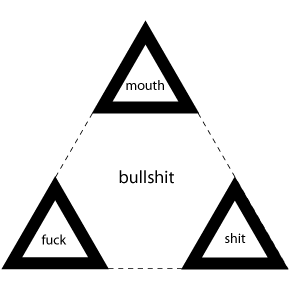 |  |  |
Cognitive self-reflexivity? As depicted above, the pattern is typical of essentially "mechanical" depictions unreflective of the paradoxical and self-reflexive cognitive challenges -- appropriately deprecated as typical "bullshit". The challenges of engaging otherwise with the "hole" -- through joined-up thinking -- are usefully indicated by the variants of the Valknut symbol below (Valknut. Norse Mythology for Smart People). These highlight the sense in which the primary characteristic of a "shithole planet" is to be caught in a knot -- perhaps the Gordian knot with which Alexander the Great was traditionally confronted (Mapping Grossness: Gordian knot of governance as a Discordian mandala? 2016).
| Joined-up thinking as suggested by variants of the Valknut symbol | ||
| Closed 3-link chain | Triquetra / Trefoil knot | Borromean ring |
 |  |  |
| Images reproduced from Wikipedia | ||
These images are helpful in suggesting that any cognitive "hole" -- as with any "shithole" -- may be more difficult to detect than might be assumed. This is especially the case if the topology of the "hole" is of multidimensional nature, whatever that might mean from an extraterrestrial perspective. This could be usefully understood in terms of any so-called logical "hole" in an argument, otherwise termed a fallacy. These may be used without realizing it, or for the purpose of confusing others. Again it is possible that ETs might be more sensitive to a wider range of fallacies than those appealing to ethos, logos, and pathos.
Detection of the "hole", qualifying Earth for "shithole" status from an ET perspective, could also be usefully compared with detection of any "Big Lie" (Existential Challenge of Detecting Today's Big Lie: mysterious black hole conditioning global civilization? 2016). Of potential relevance is the extensive debate on the hole argument, an apparent paradox in general relativity physics (John D. Norton, The Hole Argument, The Stanford Encyclopedia of Philosophy). In purely mundane terms, "finding the hole" may well be a challenge in sexual intercourse.
Configuring a sustainable planetary "shithole" through "globalization": There is an appropriate elegance to the puzzling nature of the above depictions as exemplifying joined-up thinking, given the symbolic association of Valknut with Germanic myths and Gotland -- the "land of the gods".
The relevance of such triadic symbols to this argument is discussed separately (Cognitive Implications in 3D of Triadic Symbols Valued in 2D, 2017). It is of particular interest in the light of the joined-up strategic framing currently offered by the triple helix model, as discussed separately (Reconciling triskelion and triple helix: a topological transformation with psychosocial implications? 2017).
[Parts: First | Prev | Next | Last | All] [Gallery] [Links: To-K | From-K | From-Kx | Refs ]