
Sustaining the Quest for Sustainable Answers
-
Sustaining the Quest for Sustainable Answers
Sustaining the Quest for Sustainable Answers
Comments
| Sustaining the Quest for Sustainable Answers |
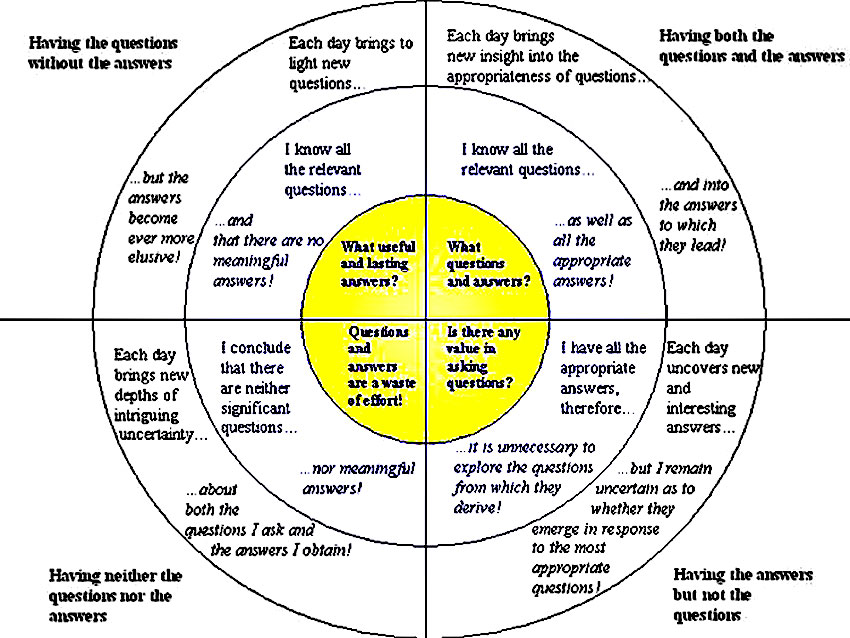 |
The above diagram endeavours to interrelate different ways of understanding questions and answers.
The four quadrants in the diagram are devoted respectively to:
- Having the questions without the answers: a situation typical of those on a quest in search of a solution for a problem they have defined. "Gurus" of various kinds may respond to them -- but possibly by encouraging them to shift to some new zone, without necessarily providing answers.
- Having the answers but not the questions: a situation typical of those committed to particular forms of action as an answer to a question that seems no longer to call for reflection. This may be highly desirable in emergency situations.
- Having both the questions and the answers: a situation typical of the learned and experienced who are no longer challenged to reflect upon their certainities. This may be the expectation placed upon educators.
- Having neither the questions nor the answers: a situation typical of those unchallenged by their environment or their relationship to it. On the other hand it may also be typical of the challenge of a highly turbulent environment in which questions and answers have to be formulated in the moment -- so that not having anticipated them may well an adavantage.
The three concentric rings in the diagram are devoted respectively to:
- Outer ring: the appreciation of questions and answers as encountered in daily life
- Middle ring: the framing of the conclusion regarding the encounter with questions and answers in daily life (in the outer ring)
- Inner ring: the existential understanding of the insights of the outer and middle rings.
The diagram as a whole can be viewed as a kind of attitudinal "gearbox" through which to navigate the world of experience. One may shift from one zone to another according to circumstances. It is unclear that the question-answer mix of any particular zone or ring is preferable in any absolute sense. There may however be circumstances in which one or another is more appropriate.
The diagram raises the question as to whether there is a need to move beyond the preoccupation with questions-and-answers. But should that question be answered?