
Systemic configuration of highly disparate cognitive modalities -- in the light of 5-ring strategy?
Tank Warfare Challenges for Global Governance (Part #10)
[Parts: First | Prev | Next | Last | All] [Gallery] [Links: To-K | From-K | From-Kx | Refs ]
Recognizing radically distinct cognitive modalities: The set of psychosocial "tanks", as tentatively presented above, deliberately obscures the very distinctive manner in which these "tanks" may be bounded as containers for quite distinctive cognitive processes (as noted briefly above). Whereas the configuration may necessarily be "global" (and therefore "unreal" in some sense), the challenge is to embody cognitive modalities which may be necessarily "local" (with an associated sense of "reality").
Appropriate consideration of such differences can be fruitfully recognized in the 5-fold distinctive modalities made in the classic Japanese strategic manual, The Book of Five Rings (Go Rin No Sho). In strategic studies, this has long been appreciated as a complement to the Chinese classic, The Art of War. The five rings are explicitly distinguished by metaphor to clarify the radical distinctions between the cognitive modalities associated with each of the five strategic approaches. As chapters of that study, they are named as:
- The Book of Earth, perhaps usefully understood as the solidity of reification and the "concrete" to which the think tank modality typically aspires
- The Book of Water, perhaps especially understood through strategic references to liquidity and the need for nimbleness -- or through crowd psychology, and the "slipperiness" of emerging leaders
- The Book of Fire, perhaps understood through recognition of the fundamentally radical, whether disruptive or innovative, or both (as with what is eperienced as inspiration and a "flash" of revelation)
- The Book of Wind, perhaps usefully understood through associations to "movements of opinion", the "winds of change", and the cultivation of narrative
- The Book of the Void, perhaps usefully understood in allusion to elusive fundamental values, notably reinforced by religious frameworks (especially through apophasis)
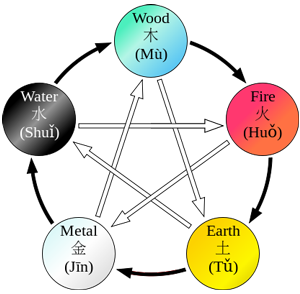
These distinctions strongly recall the 5-fold Wu Xing pattern of Chinese thinking, understood as the five types of chi dominating at different times. There is therefore the possibility of clustering the 20 (?) psychosocial modalities into five strategic categories of memetic "tank warfare" (Xiaoying Qi, Paradoxical Integration: globalised knowledge flows and Chinese concepts in social theory, University of Western Sydney, 2011).
The categories might well bear a relation to the Panchatantra (Five Treatises), an ancient Indian collection of interrelated animal fables in Sanskrit verse and prose -- the most translated work in Indian culture -- analogous to Aesop's fables. Comparison could also be explored with the Pancasila, of similar derivation, namely the official, foundational philosophical theory of Indonesia based on five principles.
In a period of major preoccupation with climate change, it is somewhat ironical to note the extent to which the metaphors above from nature are in themselves a feature of climate -- as so widely understood experientially (Weather Metaphors as Whether Metaphors, 2015).
Indicative animations of coherent tank configuration as a psychosocial ecosystem: The possibility that there is a degree of coherence interrelating the system of tanks can be pursued in the light of earlier arguments and animations (Requisite 20-fold Articulation of Operative Insights? Checklist of web resources on 20 strategies, rules, methods and insights, 2018). Of particular relevance is the coherence offered by mapping in terms of the dual configuration of icosahedron/dodecahedron -- the latter with 20 vertices -- as explored separately (Time for Provocative Mnemonic Aids to Systemic Connectivity? Possibilities of reconciling the "headless hearts" to the "heartless heads", 2018). That study includes many animations of some relevance.
The dodecahedron is characterized by 15 great circles (Fifteen Great Circles on a Sphere, Wolfram Demonstrations Project) -- appropriate to any quest for "global" configuration. The 5 rings and the 5-fold Wu Xing pattern might then correspond to five great circles rotating through its 20 vertices, as indicated below.
| Rotation showing 15 great circles through 20 dodecahedral vertices (edges on same circle similarly coloured) | 20-fold systemic configuration of "tanks" as a dodecahedron (illustrating disruption of coherence by the singular think tank modality) |
 |  |
Pattern of "trumping" alternative distinctions: Requiring further consideration is the manner in which any one ring of modalities might be understood as undermining or overriding ("dominating") any other ring -- whilst being undermined in its turn by others. Given the contrasting modality exhibited so successfully by Donald Trump (the self-acclaimed expert in deals) -- to the dismay of many committed to the staid think tank modality -- this process could be recognized in terms of what is known in contract bridge as "trumping" cards of any other suit (At Bridge Tables, 'No Trump!' Takes On a Whole New Meaning, The Wall Street Journal, 23 July 2016).
The process is recognized world wide in terms of variants of the hand-game Rock–Paper–Scissors, whether with different "weapons" or more of them. With respect to the latter, one popular 5-weapon game is " rock-paper-scissors-Spock-lizard", invented by Sam Kass and Karen Bryla. Mathematically it is recognized that as long as the number of moves is an odd number and each move defeats exactly half of the other moves. while being defeated by the other half, any combination of moves will function as such a game.
These considerations suggest visual comparison of the following, bearing in mind that it is the 3-fold Rock-Scissors-Paper which is most immediately comprehensible, with the 5-fold variants (of relevance to this argument) as a greater challenge. In the case of the Wu Xingcycle, as illustrated below, the interaction arrows can be understood as black=generating; white= overcoming.
| Suggestive comparison of cycles of interaction | ||||
| Rock-Scissors-Paper | Rock-Scissors-Paper-Lizard-Spock | Chinese 5-phase Wu Xing cycle | 5-fold Borromean rings | Discordian mandala |
 |  |  |  |  |
| Reproduced from Wikipedia | Adapted from Wikipedia | From Chanberland and Herman (2013) | Reproduced from Wikipedia | |
The 5-fold images above invite various explorations of strategic relevance (Engaging with Elusive Connectivity and Coherence: global comprehension as a mistaken quest for closure, 2018; Correlating a Requisite Diversity of Metaphorical Patterns, 2015):
- Scissors-Paper-Stone: This metaphor has been extended to 5-ring and 7-ring Borromean configurations (Marc Chamberland and Eugene A Herman, Rock-Paper-Scissors meets Borromean Rings, Grinnell College, 2014). As with the 3-ring game, the authors argue the case for 5-part and 7-part games with contrasting "weapons", noting that the number of such "games" has been extended to 13. Of relevance to this argument is whether the "weapons" are nations, as with the Group of 5 Permanent Members of the UN Security Council, the Five Eyes intelligence alliance, the Group of 7, or sets of mutually overriding strategic priorities of governance. Do 3-fold groups invite similar insight (Trilateral Commission, Trilateral Cooperation Secretariat)? What then of the viability of any cartel or crime ring, most notably triads?
- Wu Xing: Cycles of enstoning forming mnemonic pentagrams: Hygiea and Wu Xing (2012); Transformation pathways in multivocal discourse (2015)
- Borromean rings: Requisite curvature: reconciling the Triple Helix, the Triskelion and the Borromean condition (2018); Borromean challenge to comprehension of any trinity? (2018)
- Discordian mandala: Con-quest Aesthetically Reframed via the Concordian Mandala: inspired by implications of the systemantics of the Discordian Mandala (2016); Visualization in 3D of Dynamics of Toroidal Helical Coils: in quest of optimum designs for a Concordian Mandala (2016)
With the focus of discussion of the last three on insights from 3D images and animations, the question is: how can a 5-fold configurations of circles, rings or cycles be rendered more comprehensible if these imply quite distinct cognitive and strategic modalities? The images below are highly suggestive of the implication that the 5-fold pattern can only be comprehended to a limited degree, requiring instead another mode of cognitive engagement -- namely it must be "played competitively" in some way. This is consistent with efforts to understand strategy in terms of game theory, as investigated by some think tanks.
It is however the actual engagement in the game which is of relevance to this argument, given the variety of cognitive modalities then implied. This is consistent with the arguments of various authors from the perspective of cognitive psychology, As discussed separately (Body knowledge: understanding without proof, 2012), The dependence of understanding on metaphors framed by body movement can be associated with the work of a colleague of Lakoff, namely Mark Johnson (The Meaning of the Body: aesthetics of human understanding, 2007). The focus is also a preoccupation of others (Maxine Sheets-Johnson, The Primacy of Movement, 1999 and The Corporeal Turn: an interdisciplinary reader, 2009; Barbara Tversky, Mind in Motion: how action shapes thought, 2019 ).
So-called "body thinking" has also been been reviewed as characteristic of ancient China by Kuang-Ming Wu (On Chinese Body Thinking: a cultural hermeneutic, 1996). He argues that Chinese thinking is concrete rather than formal and abstract, and this is gathered in a variety of ways under the symbol "body thinking". As now argued from a Western perspective, the root of the metaphor is that the human body has a kind of intelligence in its most basic functions.
The metaphor of body thinking is extended far beyond bodily functions in the ordinary sense to personal and communal life, to social functions and to cultivation of the arts of civilization. As the metaphor is extended, the way to stay concrete in thinking with subtlety becomes a kind of ironic play, a natural adeptness at saying things with silences. Play and indirection are the roads around formalism and abstraction. Western formal thinking, he argues, can be sharpened by Chinese body thinking to exhibit spontaneity and to produce healthy human thought in a community of cultural variety.
| Contrasting illustrations of interwoven cycles in 2D and 3D | Speculative animations of the cognitive challenge | ||
| Olympic rings (original by Pierre de Coubertin) | Rattan ball used in kick volleyball (Sepak takraw) | Truncated icosahedral stitching pattern of association football | Highlighting 5-fold elements |
 |  |  |  |
| Reproduced from Wikipedia | From Requisite complexification of imagery to embody greater significance (2014) | ||
The central image recalls the recognition of the relevance of weaving to governance, notably as practiced by Mohatma Gandhi, as separately discussed (Warp and Weft of Future Governance: ninefold interweaving of incommensurable threads of discourse, 2010). This is reflected in the interest in carpet weaving by Christopher Alexander (A Foreshadowing of 21st Century Art: the color and geometry of very early Turkish carpets, 1993) as speculatively discussed (Interweaving Thematic Threads and Learning Pathways: noonautics, magic carpets and wizdomes, 2010).
Interweaving rotation of 5 great circles? In the absence of an adequate spherical weaving animation (inspired by the rattan ball above), one experimental approach to interrelating the think tanks of this argument is through great circles as illustrated by the following experimental animation. Here 5 great circles, primarily associated with two opposite pentagrams of the dodecahedron, are shown as rotating such that they variously interconnect all the 20 vertex "tanks". Missing is any indication of the "trumping" effect (interweaving) which is so fundamental to recognition that each modality may override any other, but is vulnerable to being overridden in its turn (as noted above).
| Animations of 5 great circles sweeping through 20 vertices of dodecahedron (mutually orthogonal views based on pentagrams sides, as visible on left) | |
 |  |
| Dodecahedral form via Stella Polyhedron Navigator; animations developed with X3D-Edit | |
Anticipating "global navigation" -- in cognitive terms? Arguably the current challenge of comprehending and enabling global navigation could be compared with the historical challenge of navigating the globe -- centuries ago (and a reality in practice for many today). The technical insight into the possibility of doing so only emerged from the work on the so-called Pentagramma Myrificum by the mathematicians John Napier and Carl Friedrich Gauss, as discussed separately (Global Psychosocial Implication in the Pentagramma Mirificum: clues from spherical geometry to "getting around" and circumnavigating imaginatively, 2015). The latter includes animations of relevance to the above argument, in contrast to the perspective offered by a "Flat Earth" metaphor potentially to be seen as characteristic of think tanks (Thomas L. Friedman (The World Is Flat, 2005; The World Is Flat; the globalized world in the twenty-first century, 2006).
An alternative approach to representation of interweaving and the "trumping" effect is through use of 5 helical circles (Concordian Mandala as a Symbolic Nexus: insights from dynamics of a pentagonal configuration of nonagons in 3D, 2016; Visualization in 3D of Dynamics of Toroidal Helical Coils in quest of optimum designs for a Concordian Mandala, 2016).
[Parts: First | Prev | Next | Last | All] [Gallery] [Links: To-K | From-K | From-Kx | Refs ]
Subjects: Psychology · Strategy · Form · Systems