
Objectively understood configurations indicative of fundamental cognitive implication
Framing Dynamic Transcendence of Simplistic Cognitive Polarization (Part #3)
[Parts: First | Prev | Next | Last | All] [Gallery] [Links: To-K | From-K | From-Kx | Refs ]
It is useful to explore configurations which are suggestive of richer patterns of articulation of binary distinctions -- whether explicit or by implication. Those of a purportedly objective nature might include the following.
Targets: One mode of resolving the difficulties of polarization is through decision-making -- most obviously executive decision-making, with the potential implication of eliminating the perspective of an opponent through their "execution", whereby they are "taken out". There are of course many dubious examples of the latter, most obviously in the specific targetting of the leadership of groups deemed to be a threat (Osama bin Laden, and the like) and of environmental journalists (for example). Those who could be considered to be targetted in this way notably feature on the "most wanted lists" of law enforcement agencies by whom bounties may be offered.
Of interest with respect to decision-making is the focus offered by a "target" of a physical nature (a shooting target, or "bull's eye"), as with the targetting of intercontinental missiles. A metaphorically equivalent can be recognized in the case of strategic objectives, most obviously a target market and any sense of a financial target.
Potentially problematic are implications resulting from the the uncritical use of military metaphors derived from the focus on physical targets (Enhancing Sustainable Development Strategies through Avoidance of Military Metaphors, 1998). The latter included discussion of Use of "targets" and "bullets" and Mutual targeting in a democratic process. The use of "bullets" is of course a feature of strategic presentations characterized by an array of "bullet points" whereby a target is defined or implied.
There is considerably irony to the fact that the participants in a polarized situation (and in controversies) frame their opponents as "targets" for campaigns, whereby hopefully the other party will be defeated.
It is somewhat remarkable that goals in the quest for a strategic solution should be framed by what may be recognized as a hunting metaphor -- with all that that may imply cognitively in terms of ensuring some analogue to death in the environment. Are strategic solutions to be understood as targets to be "taken out" -- as in the log-jam metaphor? Alternatively, what is the significance of creating a fatal hole in a living system -- given the mysterious nature of holes as variously explored (Terrence Deacon, 2011; Roberto Casati and Achille Varzi, 1994). Understood as a metaphor borrowed from sport, what has to be inserted where to satisfactorily transform the environment?
As a device for focusing individual or collective attention, a subtle contrast can however be recognized between a target (below left) and the cross-hairs of a reticle (below right). The latter is a pattern of fine lines or markings built into the eyepiece of a sighting device, such as a telescopic sight in a telescope, a microscope, or the screen of an oscilloscope, to provide measurement references during visual examination.
| Target and reticle | |
| Shot grouping on target | Reticle cross-hairs |
 |  |
| Binksternet, CC BY-SA 4.0, via Wikimedia Commons | Jellocube27 at English Wikipedia, Public domain, via Wikimedia Commons |

Missing from any such configuration, although implied by their use, is the cognitive reality experienced in causing some form of death through successful targetting. Reference is frequently made to this with respect to the actual experience of warfare or of being able to kill a person or an animal. The experience is given particular significance in hunting as a rite of passage ("being blooded") and in the proven capacity to kill as requirement of some urban gangs for membership (as an evocation of respect). Related practices have been evident in academic fencing in which duelling scars (German: Schmisse) were seen as a "badge of honour", a mark of membership of an upper class, and "good husband material". They have been perceived as a way of showing courage in being able to stand and take a blow, as opposed to inflicting the wound.
Given the existence of an extensive array of missiles around the globe, variously targetted on the infrastructure of distant countries, there is a case for noting the use by the United Nations Sustainable Development Goals (SDGs) of an explicit set of 169 targets. Metaphorically understood these may be understood as an array in a multidimensional strategic space through which an analogue to the military strategy of full-spectrum dominance is to be achieved by the UN with respect to global challenges. The targets are only too evident with respect to climate change: reduction of emissions, reduction of global warming.
The articulation of the 169 global targets does not seemingly offer any sense of the coherence of that pattern in systemic terms -- if pattern there is -- and has attracted specific criticism (The 169 Commandments: the proposed sustainable development goals would be worse than useless, The Economist, 28 March 2015). Rather than accept that criticism, and in the spirit of the argument developed here, there is a case for tentatively envisaging how those targets might be coherently configured in a multidimensional space. The approach follows from that indicated separately (Identifying Polyhedra Enabling Memorable Strategic Mapping: visualization of organization and strategic coherence through 3D modelling, 2020).
As with the absence of any suitable polyhedra for mapping the 17 SDGs beyond their tabular arrangement, none was apparent for the 169 targets. Relatively simple mapping possibilities are however available for the 16 primary goals (Functional dynamics of a 16-fold configuration of strategic goals, 2019). The exercise here therefore focused on a polyhedron with 168 vertices (of 8 types) with which targets might then be associated, namely the dual of the so-called "12 Gishi Slice 25" in 4D -- of which a 3D projection can be visualized in 3D as shown below. The Gishi "regiment" is one of 16 regular polychora (or regular 4-polytopes).
The requisite complexity of the multidimensional structure is notably indicated by the manner in which visible vertices are indicated with three conflated numbers of the 168 (below left). The coherence can be variously indicated by colouring options for the edges (parallel, great circle, same type, etc).
| Exploratory configuration of 168 targets of the UN Sustainable Development Goals (presented as a 3D projection of a 4D structure -- a polychoron) | |
| Animation | Animation with alternative colouring option |
 |  |
| Animations prepared using Stella Polyhedron Navigator | |
The 4 nested "layers of coherence" can be further indicated by selectively highlighting faces of different types to reveal nested structures as shown below -- the outermost being an icosahedron.
| Potential coherence of 168 targets of the UN Sustainable Development Goals (highlighting face patterns of 3D projection of a 4D structure) | |||
 |  |  |  |
| Prepared using Stella Polyhedron Navigator | |||
Dartboard: There is an intriguing contrast between a target and a dartboard in that the former is widely adapted for metaphorical purposes whereas the latter is a feature of a widely known physical game involving use of darts (as a substitute for "bullets"). As a metaphor, it is only the seemingly unrelated notion of a "dashboard" that is used for navigation purposes (most notably in vehicles and on web sites) without taking the circular form of a target.
Points can be scored by hitting specific marked areas of the board, though unlike in sports such as archery, these areas are distributed all across the board and do not follow a principle of points increasing towards the centre of the board.
| Dartboard and score configuration | |
| Typical dartboard | Scores for each region of a dartboard (not to scale, shaded by value) |
 |  |
| Tijmen Stam, CC BY-SA 3.0, via Wikimedia Commons | Cmglee, CC BY-SA 4.0, via Wikimedia Commons |


Mathematical studies have considered the design of an "optimal" dartboard among the many possible alternatives. It is somewhat curious to note that these share a focus on factorial 19, given that this number is so fundamental to the design of a Chinese go board.
Magic circles: There is a fair degree of familiarity with magic squares, especially in recreational mathematics. Far less evident is the importance attached to them by Benjamin Franklin, one of the Founding Fathers of the US -- also renowned in Freemasonry, for which such squares are of symbolic significance (Magic Squares, Masonic Dictionary; Paul Pasles, Franklin Squares 2006; Benjamin Franklin's Numbers: an unsung mathematical odyssey, Princeton University Press, 2007). Of particular relevance to this argument is how any sense of "magic" relates both to comprehensibility and to memorability, and more especially in the case of magic circles -- or those of higher dimensionality.
Franklin called his 16x16 magic square the most magically magical of any magic square ever made by a magician -- with which many mathematicians and mystics would now be held to agree, as separately discussed (Magic square integrity and implications for the US Constitution, 2015). The following animations are reproduced from the latter, although how these may have influenced the elaboration and operation of that Constitution remains far less evident.
| Franklin's 16x16 magic squares: animations of movement of selected bent diagonals | ||
| Vertical movement | Combined movement | Horizontal movement |
 |  |  |
Magic circles were invented by the Song dynasty (960–1279) Chinese mathematician Yang Hui (c. 1238–1298). These are the arrangement of natural numbers on circles where the sum of the numbers on each circle and the sum of numbers on diameter are identical. One of his magic circles (below left) was constructed from 33 natural numbers from 1 to 33 arranged on four concentric circles, with 9 at the centre.
Examples of magic circles and magic sphere | |||
| Magic circle (Yang Hui) | Magic circle (Ding Yidong) | Magic circle from square | Andrews's magic sphere |
| numbers on each circle and diameter sum to 138 (ignoring the middle 9) | numbers on each circle (solid colour) sum to 200 and numbers on each diameter (dashed grey) sum to 325 | derived from 4x4 most-perfect magic square, containing numbers 1 to 32, with each circle and diameter totalling 132 | numbers 1 to 62 arranged along intersections of 5 circles of latitude (dashed grey) and 6 circles of longitude (coloured solid), each circle has 12 numbers totalling 378 |
 |  |  |  |
| Cmglee, CC BY-SA 4.0, via Wikimedia Commons | Cmglee, CC BY-SA 4.0, via Wikimedia Commons | Cmglee, CC BY-SA 4.0, via Wikimedia Commons | Cmglee, CC BY-SA 4.0, via Wikimedia Commons |


The argument can be developed in the light of the geometric magic square as indicative of a new way of thinking about the UN Sustainable Development Goals, as an extension of an earlier argument in relation to the Rubik Cube (Interplay of Sustainable Development Goals through Rubik Cube Variations Engaging otherwise with what people find meaningful, 2017).
Flow diagrams: There are numerous accessible circular flow diagrams (although typically subject to copyright), whether of systemic significance or otherwise. These include representations of:
- circular economy (The Circular Economy in Detail, Ellen MaArthiur Foundation, 2017)
- systems development life cycle
- circular flow diagrams of governance economics
- circular sequencing of human genes by pathways
- circular data visualization
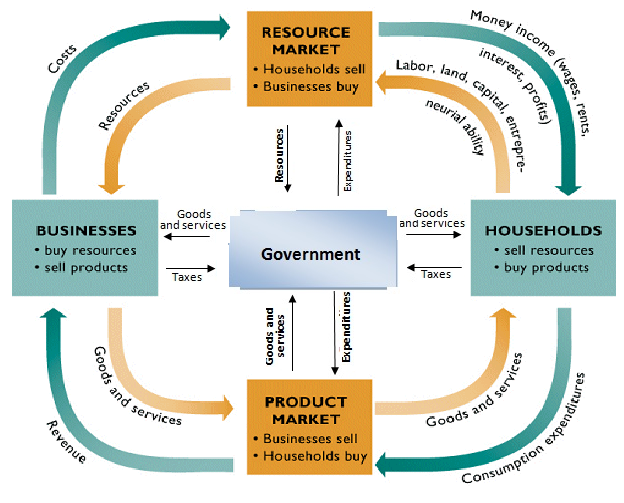


It is appropriate to note that circular flow diagrams may be primarily indicative of flow around an empty centre and with little systemic interaction across the circle.
Classificatory configurations: Flow diagrams are to be contrasted with approaches to circular classification in which categories are nested to various degrees in a circular configuration -- but with little explicit indication of system links between the categories configured. Typically subject to copyright, they include:
- Bloom's taxonomy, namely the many visualizations of a set of three hierarchical models used to classify educational learning objectives into levels of complexity and specificity. The three lists cover the learning objectives in cognitive, affective and sensory domains. (Tips for Writing Instructional Objectives - Bloom's Taxonomy Job Aids, Social Learning Systems, 25 July 2009)
- Functional classification of proteins based on protein interaction data (What-When-How.com) as a feature of proteomics
- circular periodic tables of the chemical elements exist in many accessible variants, many of which feature a spiral organization
| Examples of circular/spiral configurations of periodic table of chemical elements | ||
| TROPE ring of periodic elements | Harrison Spiral Periodic Table | |
 |  |  |
| Alexander Braun, CC BY-SA 3.0, via Wikimedia Commons | Robert W Harrison, CC BY-SA 3.0, via Wikimedia Commons | Cbuckley at English Wikipedia, CC BY 3.0, via Wikimedia Commons |


Systems biology makes use of circular cladograms and dendrograms and phylogenetic trees. A related diagrammatic approach to cognitive biases is that of the Cognitive Bias Codex. as discussed separately with animations (Global configuration of cognitive biases: towards mapping G7 susceptibility, 2018).
| Phylogenetic tree | Cognitive bias codex |
| Highly resolved, automatically generated tree of life, based on completely sequenced genomes | |
 |  |
| Ivica Letunic: Iletunic. Retraced by Mariana Ruiz Villarreal: LadyofHats, Public domain, via Wikimedia Commons | By Jm3 [CC BY-SA 4.0], from Wikimedia Commons |


Genetic code: There is of course intense focus on the genetic code as fundamental to the organization of life. More commonly these are represented in tabular form (DNA and RNA codon tables). RNA and DNA are polymers made of long chains of nucleotides, the basic building block of nucleic acids.. A nucleotide consists of a sugar molecule (either ribose in RNA or deoxyribose in DNA) attached to a phosphate group and a nitrogen-containing base. The bases used in DNA are adenine (A), cytosine (C), guanine (G), and thymine (T). In RNA, the base uracil (U) takes the place of thymine. Nucleotides contain either a purine or a pyrimidine base.
There are however numerous circular configurations of the 64 genetic codons accessible on the web ("circular genetic code" or "codon circle"), with explicit indication of the manner of their nested articulation, as indicated below. The DNA variant below centre is reproduced from an explanatory discussion by Vijini Mallawaarachchi (Starting off in Bioinformatics: turning DNA sequences into protein sequences, Towards Data Science, 13 August 2017).
| Examples of circular configurations of genetic codon tables | ||
| Standard RNA codon table | DNA variant of codon table | In preparation |
 |  |  |
| Mouagip, Public domain, via Wikimedia Commons | Reproduced from Genetic Code Chart for DNA | |

The associated circularity is itself a feature of studies including:
- Jerome Lacan and Christian Michel: Analysis of a circular code model (Journal of Theoretical Biology, 213, 2001)
- Christian Michel: Circular Codes in Genes (Université Louis Pasteur de Strasbourg, 2007)
- Christian Michel: A 2006 review of circular codes in genes (Computers and Mathematics with Applications, 55, 2008, 5)
- Anton A. Komar: The "periodic table" of the genetic code: a new way to look at the code and the decoding process (Translation, 4, 2016, 2)
Whilst such diagrams, whether tabular or circular, are recognized as a key to the organization of life, it is somewhat curious that the dynamics of whatever constitutes "life" are only evident in them by implication (if at all), if only with respect to mutation. The genetic code was once believed to be universal, with a codon coding for the same amino acid regardless of the organism or source. It is now accepted that it might vary more frequently than was thought (Variations in the genetic code of life, New Scientist, 1 May 2006). While there is much commonality, different parts of the tree of life use slightly different genetic codes (List of genetic codes).
It is now agreed that the genetic code evolves, resulting in discrepancies in how a codon is translated depending on the genetic source. Arguably the quest for alien life on Mars and elsewhere could be understood as a desperate need to clarity such matters, given the importance attached to that quest and the resources expended.
[Parts: First | Prev | Next | Last | All] [Gallery] [Links: To-K | From-K | From-Kx | Refs ]